
Listen to this article:
The early months of 2026 have proven difficult for Xpeng. The company’s latest financial results reveal a stark contraction in both volume and revenue, painting a picture of a manufacturer caught in the crosshairs of shifting subsidies and intense domestic competition in China. While many EV players are navigating a period of consolidation, Xpeng’s numbers suggest a more profound struggle to maintain momentum.
A Sharp Decline in Deliveries and Revenue
According to the latest quarterly report, Xpeng delivered 62,682 vehicles in the first quarter of 2026. This represents a 33% year-on-year drop from the 94,008 units delivered during the same period in 2025. The decline is even more pronounced when compared to the fourth quarter of 2025, where the company reached 116,249 deliveries.
The financial impact of this volume drop is evident in the company's top line. Total revenue for Q1 2026 stood at 13.03 billion yuan (approximately €1.65 billion), a 17.6% decrease compared to Q1 2025. More concerning for investors is the revenue from vehicle sales specifically, which fell by 23.5% year-on-year to 11 billion yuan. This decline has directly contributed to a widening net loss, which reached 1.78 billion yuan (€225 million), a significant jump from the 0.66 billion yuan loss recorded in Q1 2025.
While some of this decline can be attributed to seasonal trends—such as the traditional slowdown during the Chinese New Year—the scale of the drop distinguishes Xpeng from some of its peers. For instance, Nio reported doubling its sales and revenue in the same period, suggesting that Xpeng's challenges may be more internal or specific to its product mix rather than a general market downturn.
The Subsidy Shift and Competitive Pressure
The Chinese EV market is currently undergoing a period of structural change. At the turn of the year, several key electric vehicle subsidies were reduced, altering the purchasing landscape for many consumers. This, combined with a saturated market where brands like BYD and Xiaomi are aggressively expanding, has created a "price war" environment that squeezes margins for mid-tier manufacturers.
For European observers, this is a critical development. As Chinese manufacturers face pressure at home, they often look toward international markets, including Europe, to find growth. However, if Xpeng continues to struggle with profitability in its home market, its ability to fund the massive R&D required for global expansion may be compromised.
The Volkswagen Connection: A Financial Lifeline?
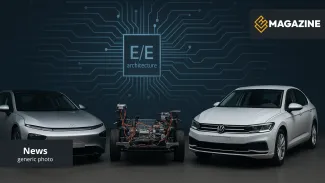
One area of unexpected strength in Xpeng's report is its "services and other activities" revenue, which surged by 41.2% year-on-year to 2.03 billion yuan. This growth is largely driven by technical research and development services. This is a direct result of Xpeng's strategic partnership with Volkswagen, which holds a 5% stake in the company.
The collaboration has already yielded tangible results with the launch of the ID. Unyx 07 and ID. Unyx 08 in China. This partnership provides Xpeng with a crucial secondary revenue stream, decoupling some of its financial health from pure vehicle sales and validating its technology on a global stage through one of Europe's largest automotive groups.
The Xpeng GX: The Flagship Hope
To combat the sales slump, Xpeng has recently launched its new flagship SUV, the Xpeng GX. Unveiled in February and officially hitting the market on 20 May 2026, the GX is designed to compete in the premium segment, visually echoing the commanding presence of a Range Rover.
Technologically, the GX is a significant leap forward. It features a Bosch steer-by-wire system, a technology that replaces the traditional mechanical connection between the steering wheel and the wheels with electronic signals. This allows for variable steering ratios and improved maneuverability, especially in tight urban environments. Furthermore, the GX is being produced alongside a dedicated Robotaxi version, signaling Xpeng's commitment to autonomous mobility.
Looking Ahead: Physical AI and Robotaxis
CEO He Xiaopeng is not just looking at selling more cars; he is looking at a fundamental shift in the company's identity. He has stated that Xpeng is dedicated to the mass production of Robotaxis and humanoid robots, aiming to transform "physical AI technologies" into new growth drivers.
By integrating advanced AI into both vehicles and robotics, Xpeng is attempting to move beyond being a mere car manufacturer and into the realm of a high-tech mobility and automation provider. Whether this ambitious pivot can offset the current financial losses remains the defining question for the company in the second half of 2026.
Why did Xpeng's deliveries drop so much in Q1 2026?
The decline is attributed to a combination of seasonal factors (the Chinese New Year), the reduction of EV subsidies in China at the start of the year, and intense competition within the Chinese domestic market.
What is the significance of the Volkswagen partnership for Xpeng?
Volkswagen's 5% stake and partnership allow Xpeng to generate significant revenue through R&D services. This has helped bolster Xpeng's income even when vehicle sales have declined.
What is "steer-by-wire" technology mentioned in the Xpeng GX?
Steer-by-wire is an electronic system that replaces the mechanical steering column with sensors and actuators. This allows for more flexible steering, better safety features, and more compact vehicle designs.