
Listen to this article:
How the Dutch Pilot Works
The mechanics are straightforward but technically demanding. Each participating household receives a bidirectional charging station — installed free of charge — capable of both drawing power from the grid and sending it back from the vehicle's battery. Vattenfall takes control of the charging and discharging cycle, automatically managing the flow so that the cars release stored electricity between 4 pm and 9 pm, precisely when Dutch household and industrial demand peaks.
Participants set their own parameters — a departure time and a minimum battery charge level — and the system handles the rest within those guardrails. For the full six-month duration, Vattenfall reimburses electricity charged at home, capped at €500 per household. "Electric cars are stationary for most of the day," explained Jeroen van Loon, Director of Customer Solution Development at Vattenfall Netherlands. "At the same time, they have a large battery: whereas a home battery is usually around 10 kilowatt-hours, an electric car can easily have 50 to 60 kilowatt-hours of storage."
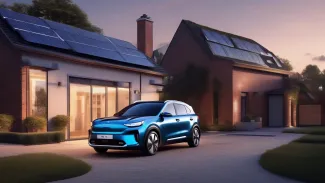
The Kia EV9 is the first vehicle model to receive official pre-certification from Dutch grid operators for V2G operation — a significant regulatory milestone that removes a key barrier to wider adoption. Hyundai and Kia supply both the charging hardware and the companion smartphone app that gives drivers visibility into their car's charging sessions and energy flows.
Why the Netherlands Is Leading on V2G
The Netherlands is emerging as Europe's de facto testing ground for bidirectional charging, and the reasons are structural. The Dutch power grid is among the most congested on the continent, with network operators in provinces like Utrecht, North Brabant and Gelderland regularly hitting capacity limits. A distributed fleet of electric vehicles that can absorb solar generation at midday and release it during the evening rush offers a pragmatic alternative to costly grid reinforcement — one that uses infrastructure already parked in Dutch driveways.
The Vattenfall pilot is not happening in isolation. Utrecht already runs the high-profile "Utrecht Energized" programme, which has deployed 50 bidirectional Renault cars through carsharing operator MyWheels and aims to scale to 500 vehicles. Eindhoven has its own grid-stabilisation project using bidirectional carsharing fleets. Until recently, however, Dutch regulation actively discouraged V2G through double energy taxation — households were taxed once when charging their car and again when supplying power back to the grid. Regulators have now begun addressing this barrier, clearing the path for projects like the Vattenfall-Hyundai-Kia trial.
The German Front: Enercity Trades Fleet Power on the Exchange
Simultaneously, across the border in Germany, a separate but thematically linked milestone was reached. Hanover-based utility Enercity successfully traded electricity from a fleet of 12 Volkswagen ID. Buzz vehicles on the continuous intraday energy market — the first time a real-world B2B fleet has operated as a virtual storage asset on a power exchange.
Over a 53-hour window in early May, Enercity's algorithm executed 145 trading transactions, buying electricity when prices were low and selling it back when prices spiked. The aggregated cluster of 12 bidirectional charging points reached a technical capacity of 0.132 MW — barely above the 0.1 MW minimum threshold for exchange participation — but the project proved that algorithmically managing a commercial EV fleet as if it were a stationary battery is no longer just a simulation exercise. The trial even generated a low three-figure revenue, though Enercity declined to disclose the exact amount.
Yet Enercity's experience also highlights the regulatory thicket that still surrounds V2G in Europe. The company emphasised that a viable business model depends on whether electricity temporarily stored in vehicle batteries can be treated identically to energy held in stationary systems — particularly regarding grid fees, levies and the prevention of double taxation. Germany's Federal Network Agency (Bundesnetzagentur) is currently assessing these questions under the AgNes framework, and Enercity does not expect an interim regulatory solution before late 2028.
Vattenfall's Broader European V2G Ambitions
The Dutch pilot fits into a wider strategic push by the Hyundai Motor Group, which announced at the end of 2025 that it would accelerate the rollout of Vehicle-to-Everything (V2X) services across South Korea, parts of Europe, and the United States. Vattenfall, meanwhile, is already running a separate V2G trial in Sweden involving 200 Volkswagen EVs and bidirectional chargers from Ambibox, operated through housing associations in Hudiksvall and beyond.
This multi-front approach — consumer trials in the Netherlands, fleet-based trading in Germany, housing-association pilots in Sweden — suggests that European utilities are treating V2G not as a distant concept but as a near-term operational tool for grid management. The challenge now shifts from proving the technology works to building the regulatory and commercial framework that makes it economically sustainable at scale.
What This Means for European EV Owners
For the average European EV driver, the implications are tangible. A car with a 77 kWh battery — the size of the Kia EV9's pack — could, in theory, power a typical household for four to five days. Even a modest V2G setup that discharges 10–15 kWh during peak evening hours could offset a substantial portion of a household's electricity bill while contributing to grid stability. If regulatory frameworks across the EU align to eliminate double taxation and standardise compensation mechanisms, the economic case for bidirectional-capable EVs becomes hard to ignore — transforming the electric car from a transport asset into a distributed energy resource that pays for itself when parked.
What is the difference between V2G and V2H?
Vehicle-to-Home (V2H) sends electricity from the car's battery directly to the household, powering appliances and reducing grid draw. Vehicle-to-Grid (V2G) feeds electricity back into the public grid, helping balance overall supply and demand. The Vattenfall pilot in the Netherlands enables both modes, though the primary use case during the trial is feeding the grid during peak hours between 4 pm and 9 pm.
Which electric cars currently support bidirectional charging in Europe?
The Kia EV9 is the first model to receive official pre-certification from Dutch grid operators for V2G operation. The Hyundai IONIQ 9, also included in the pilot, supports the same capability. Other models with bidirectional hardware include the VW ID. Buzz, and several Renault models used in the Utrecht Energized programme. However, software enablement and regulatory approval vary by country and grid operator — having the hardware does not automatically mean V2G is available to the owner.
Can European EV owners make money from V2G today?
Not yet at a commercial scale. While the Enercity project in Germany demonstrated that trading fleet EV power on the energy exchange can generate revenue, the regulatory framework for individual consumers remains incomplete. Key issues — including double taxation of stored electricity, grid fee structures for mobile storage, and standardised compensation — are still being addressed by national regulators. The Vattenfall pilot reimburses electricity costs as a research incentive, not as a commercial tariff. Broad consumer monetisation is expected only after frameworks like Germany's AgNes are finalised, likely around 2028.