
Listen to this article:
The "Pace Car" That Hides a Digital Future
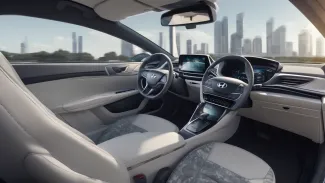
At first glance, the prototype spotted near Hyundai's European R&D hub looks like nothing more than a standard IONIQ 6 undergoing a routine mid-cycle refresh. The familiar streamlined silhouette remains untouched. But a glance through the windows reveals a different story: mounted above the factory dashboard sits a second display running Pleos Connect, Hyundai's next-generation infotainment system unveiled just last month. The choice of the IONIQ 6 as the development mule is no coincidence. Hyundai Motor Group has publicly confirmed that its first fully software-defined vehicle — scheduled for market introduction in late 2027 — will be built around a "pace car" heavily derived from the IONIQ 6 platform. By embedding the new software architecture into a proven electric vehicle chassis now, engineers can validate over-the-air update processing, centralised computing units, and real-time data connectivity long before the final production hardware is signed off. The European testing location is particularly significant: the continent's dense and diverse road networks, stringent data regulations, and rapidly expanding EV charging infrastructure make it an ideal laboratory for connected car validation.Pleos Connect: Hyundai's Answer to the Smartphone-on-Wheels
Pleos Connect represents Hyundai's first tangible step toward becoming what it calls a "software-centric mobility leader." The system, which debuted on the Grandeur sedan in South Korea in April 2026, borrows several concepts familiar to Tesla owners — a customisable app-based layout, a large central touchscreen divided into logical zones, and a persistent bottom bar for frequently used applications. However, Hyundai diverges from Tesla's approach in one crucial respect: it retains a secondary driver display for speed, media, and turn-by-turn navigation, so the driver never has to glance at the central screen for essential driving information. More importantly, Hyundai has kept physical climate controls and steering wheel buttons — a deliberate choice that acknowledges European customer preferences for tactile interfaces while driving at motorway speeds. This is not a wholesale abandonment of traditional ergonomics but a selective integration of digital capability. The company has committed to rolling out Pleos Connect to approximately 20 million Hyundai, Kia, and Genesis vehicles by the end of the decade, making it one of the most ambitious infotainment deployments in automotive history.A Unified Cabin Language Across the Lineup
Beyond the software, the IONIQ 6 prototype reveals a redesigned steering wheel that matches the minimalist layout recently spotted in IONIQ 5 interior prototypes. This is a telling detail. The new wheel abandons today's button-heavy configuration in favour of a streamlined interface centred on a prominent roller-style scroller flanked by just two primary selection keys. By implementing the same physical interface across both the IONIQ 5 and IONIQ 6 development mules — and almost certainly across the entire upcoming generation — Hyundai is signalling a standardised approach to physical controls that works in concert with the digital ecosystem, rather than competing with it. For European drivers who switch between company cars, rental vehicles, and family cars within the same brand, this consistency reduces the learning curve and enhances perceived quality.The AI Co-Pilot: Gleo and the Learning Cabin
Perhaps the most forward-looking element of Hyundai's SDV architecture is Gleo AI, an intelligent voice companion built on a large language model. Unlike today's basic voice commands that require rigid phrasing, Gleo is designed to understand natural conversational requests — "find a restaurant near me," "navigate to the nearest charger," or "what's the news in Brussels today" — and, critically, it keeps learning from each interaction. Hyundai plans to develop the AI over several years, suggesting that the companion will grow more personalised and context-aware with every over-the-air update. For European users navigating multiple languages, regional accents, and cross-border driving, a genuinely intelligent voice assistant could prove more useful than flashier autonomous features that remain regulatory quicksand on this side of the Atlantic.What This Means for Europe's EV Landscape
Hyundai's decision to base its SDV testing programme at HMETC rather than solely at its Namyang headquarters in South Korea sends an unequivocal message: Europe is the priority market for this technology. The continent is rapidly becoming a battleground for software-defined vehicles. Volkswagen's troubled CARIAD division is racing to deliver its delayed software platform, BMW has invested heavily in its own operating system, and Mercedes-Benz continues refining its MB.OS architecture. Meanwhile, Chinese entrants like BYD and Xpeng arrive with sophisticated digital ecosystems honed in the world's most demanding tech market. Hyundai's approach — blending Tesla-style software ambition with traditional ergonomic common sense — could occupy a sweet spot. European EV buyers have shown they want advanced connectivity, but they also consistently rank physical controls and ease of use among their top purchasing criteria. A vehicle that updates itself wirelessly while maintaining familiar, intuitive physical interfaces might be precisely what the market is waiting for. The IONIQ 6 pace car testing is, in essence, a preview of Hyundai's entire strategic identity for the next decade. If the Korean manufacturer gets the balance right — European testing grounds, European customer sensibilities, and software ambition that doesn't sacrifice usability — the late-2027 SDV launch could position Hyundai ahead of several legacy rivals who have spent billions on software with little to show for it yet.When will the first Hyundai SDV arrive in Europe?
Hyundai has confirmed that its first fully software-defined vehicle will launch in late 2027. Given that testing is already underway at the European Technical Centre, European availability is expected to coincide with or closely follow the global debut.
How does Pleos Connect differ from Tesla's infotainment?
Pleos Connect offers a similar customisable app-based interface, but retains a dedicated driver display ahead of the steering wheel and physical buttons for climate and audio controls — elements Tesla has removed. It also integrates the Gleo AI voice assistant built on a large language model.
Will existing Hyundai EVs receive Pleos Connect via an update?
Current-generation vehicles, including the IONIQ 5 and IONIQ 6, are built on different hardware architectures and will likely not receive the full Pleos Connect experience. Over-the-air updates will continue for existing models, but the new system requires the underlying SDV computing platform arriving in late 2027.
Sources: Electrek / Korean Car Blog / Hyundai Motor Group press materials. Images courtesy of SH Proshots.
Source: https://electrek.co/2026/05/27/hyundai-testing-new-sdv-setup-in-ioniq-6-ev-images/