Listen to this article:
The race to make electric vehicles more affordable often focuses on batteries, but the drivetrain is just as critical. Hyundai Mobis has now thrown down a marker that could change how the industry thinks about scaling EV production. On 7 May 2026, the South Korean automotive supplier announced it had completed development of a 160 kW Power Electric (PE) system—a universal drive unit that the company intends to offer to automakers worldwide.
Unlike the bespoke powertrains traditionally developed for individual models, this new system is designed as a platform solution. It can be adapted across vehicle segments with minimal re-engineering, a shift that promises to cut development timelines and production costs for manufacturers still navigating the expensive transition away from combustion engines.
What Makes the PE System Different
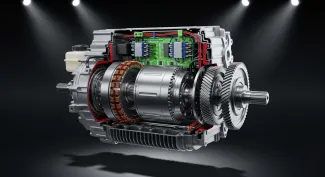
A Power Electric system is the EV equivalent of an internal combustion engine paired with a transmission. Hyundai Mobis’s unit combines three core components: an electric motor, an inverter, and a reduction gear. Together, they convert DC battery current into the mechanical force that turns the wheels.
The 160 kW output translates to roughly 215 horsepower in conventional terms—more than enough for the average family EV. For performance-oriented models, manufacturers can install one unit on the front axle and another on the rear, delivering a combined 320 kW (approximately 430 hp). That is firmly in the territory of sport sedans and premium SUVs.
What sets this system apart is not just the numbers, but the architecture. Hyundai Mobis has standardised the stator, inverter, and power module across the range. By treating these as modular building blocks, the company can mix and match components to suit different vehicles without returning to the drawing board each time. This approach contrasts sharply with the traditional model, where car makers collaborated with multiple suppliers to develop separate components and then assembled them into a working system.
Lighter, Smaller, and More Efficient
Despite being designed as a universal product, the 160 kW system improves on several metrics that directly affect driving range and cabin space. Specific power—output per unit of weight—has risen by roughly 16 percent compared with previous generations. At the same time, the overall volume has shrunk by nearly 20 percent.
Those gains matter. A more compact drivetrain frees up room for batteries, luggage, or passenger space. It also reduces the overall mass of the vehicle, which in turn lowers energy consumption and extends range.
Hyundai Mobis achieved this by applying new motor-cooling technology that dissipates heat more effectively under heavy loads. The power module, which contains the semiconductors responsible for switching electrical current, has also been optimised to maximise energy efficiency during the conversion process. Less energy lost as heat means more energy reaching the road.
A Three-Tier Lineup for Every Segment
The 160 kW unit sits in the middle of a planned trio. Hyundai Mobis had already finalised a 250 kW high-performance system in 2025, aimed at premium and performance vehicles. Before the end of the first half of 2026, the company expects to complete a 120 kW compact version tailored for small urban cars and emerging markets where cost and packaging constraints are tightest.
The full range will then cover:
- 120 kW – minimised size and weight for city cars and price-sensitive markets
- 160 kW – the universal workhorse for mass-market EVs
- 250 kW – high-output variant for flagship sedans and large SUVs
This breadth gives Hyundai Mobis the flexibility to pitch its technology to a wide spectrum of manufacturers, from budget-oriented brands to established premium marques.
From Contract Manufacturer to Global Supplier
For Hyundai Mobis, the announcement marks a strategic pivot. Until now, the company produced PE systems mainly as a contract manufacturer, building units to the designs supplied by its customers. The new systems are the result of in-house R&D, with proprietary designs for every major component.
That shift carries commercial significance. Owning the design intellectual property allows Hyundai Mobis to sell finished product models to any interested buyer, much as it already does with battery systems. The company has confirmed that overseas customers have already expressed interest, though it has not named them.
By controlling both design and mass production, Hyundai Mobis also expects to improve profitability. Vertical integration from engineering through to the factory floor typically reduces unit costs and tightens quality control—both critical factors as EV competition intensifies globally.
Why European Buyers Should Care
Europe’s EV market is maturing, but sticker prices remain a stubborn barrier for many consumers. A significant chunk of that cost lies in the drivetrain and battery pack. If modular, standardised components can trim engineering expenses for car makers, some of those savings may eventually filter down to showroom prices.
More immediately, the emergence of a capable third-party supplier like Hyundai Mobis adds competition to a sector long dominated by in-house divisions at major automakers and a handful of specialist firms. For smaller brands or new entrants without the capital to develop their own electric powertrains from scratch, an off-the-shelf 160 kW system that is proven, compact, and efficient could be an attractive shortcut to market.
Hyundai Mobis has not yet announced which vehicles will debut the new system, but its track record suggests the technology will surface first within the Hyundai and Kia lineups before spreading to external clients. Given the company’s existing battery contracts with international manufacturers, the path to broader adoption appears already paved.
What exactly is a PE system, and how does it differ from a standard electric motor?
A Power Electric (PE) system is a complete drivetrain unit that includes not only the electric motor but also the inverter—which converts DC battery power to AC for the motor—and a reduction gear that transfers torque to the wheels. It functions as the full replacement for an engine and gearbox in a combustion car, rather than just the motor alone.
Can Hyundai Mobis sell these powertrains to competing car brands?
Yes. Hyundai Mobis operates as an independent automotive supplier and is actively marketing its PE systems to global customers outside the Hyundai Motor Group. The company already supplies battery systems to international manufacturers and now aims to replicate that model in the drivetrain sector.
How does modular design help reduce EV costs?
By standardising core parts like the stator, inverter, and semiconductors, Hyundai Mobis allows car makers to reuse and scale the same architecture across multiple models. This avoids the expense of developing a unique drivetrain for every new vehicle, shortens development cycles, and simplifies mass production—ultimately helping to bring down the cost of electric cars.