Listen to this article:
For years, the phrase "electric AMG" sounded like an oxymoron to enthusiasts. The Affalterbach brand built its reputation on thundering V8s, tire smoke, and a distinct sense of mechanical drama that seemed impossible to replicate with batteries and motors. That perception is exactly what Mercedes-AMG is now preparing to shatter.
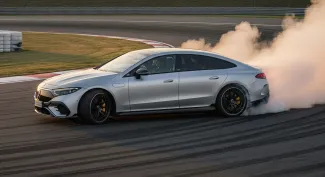
In a newly released testing video, AMG has offered the most revealing look yet at its upcoming four-door electric grand tourer — a car the company describes as one of the most ambitious projects in its history. The footage shows camouflaged prototypes sliding sideways on test tracks, billowing tire smoke, and behaving in ways that would look perfectly natural for a 63-badged sedan with a twin-turbo V8 under the hood. Except this car has no exhaust pipes at all.
A Platform Built From Scratch for Performance
What makes this EV different from Mercedes-Benz's existing electric lineup is that it rides on an entirely bespoke architecture. The AMG.EA platform was developed in-house by AMG and is not shared with any Mercedes-Benz model. It is an 800-volt architecture, which places it firmly in the top tier of current EV technology alongside the Porsche Taycan and Audi e-tron GT.
Perhaps more importantly, AMG has invested heavily in motor technology. In 2021, Mercedes-Benz acquired YASA, a British specialist in axial-flux electric motors based in Oxford. These motors are fundamentally different from the radial designs used in most EVs. They are roughly one-third the size and two-thirds the weight of conventional units, yet deliver approximately three times the power density.
The upcoming AMG GT four-door EV uses three of these YASA axial-flux motors: one powering the front axle, and two mounted at the rear — one for each wheel. This tri-motor configuration is not just about raw output. It is about control.
Precision Torque Vectoring and the Art of the Drift
Having individual rear motors allows AMG to perform torque vectoring with a level of precision that a single rear motor simply cannot match. Instead of relying on brakes to shuffle power side to side, the system can send exactly the right amount of torque to each rear wheel in milliseconds. The result is a car that can hold and adjust dramatic drift angles with what AMG engineers suggest is almost intuitive behaviour.
Mercedes-AMG has also developed a new driving dynamics control system called AMG Race Engineer. Rather than burying settings inside touchscreen menus, the car provides three physical rotary dials on the centre console:
- Response Control – adjusts how aggressively the motors react to accelerator inputs
- Agility Control – alters behaviour around the vertical axis, allowing the driver to dial in more oversteer
- Traction Control – offers nine distinct levels of slip allowance, from full intervention to virtually none
During testing, Mercedes Formula 1 driver George Russell — who has driven some of the fastest racing machinery on the planet — described the prototype as "one of the most insane cars" he had ever experienced. According to AMG, Russell noted that he needed less than 40 percent throttle to initiate and hold impressive powerslides on the track.
The Sound of a V8 — Except It Is Not
Here is where AMG's approach becomes genuinely controversial — and genuinely interesting. The company has not simply added synthetic noise through speakers. It has engineered what it calls a simulated naturally aspirated V8 experience, complete with fake gear shifts operated via steering wheel paddles, overrun crackles, and a rising crescendo of engine noise.
But AMG went further. The seats are fitted with what appear to be resonators that vibrate in sync with the simulated engine. When the driver accelerates, the seat subtly rumbles under the occupant's back in a crescendo that mimics the mechanical feedback of a large-displacement V8. Lift off the throttle, and the overrun pops and crackles travel physically through the seat structure. It is theatrical, deliberate, and — according to early passengers — surprisingly convincing.
For those who find the idea of fake engine noise in an EV absurd, the system can be turned off entirely. But AMG's bet is clear: a significant portion of its customer base wants the emotional experience of a combustion AMG, even if the powertrain underneath is entirely electric.
Power and Performance Figures
While AMG has not officially confirmed final production specifications, the indicators point to staggering numbers. The Concept AMG GT XX that previewed this car showcased a tri-motor output of 1,341 horsepower (1,000 kW). The production model is expected to deliver over 1,000 horsepower, which would place it in direct competition with the most powerful Porsche Taycan variants and the upcoming electric Porsche Cayenne.
The concept also demonstrated the platform's thermal and charging potential. With an NCMA cylindrical cell battery pack and advanced per-cell oil cooling, the architecture demonstrated average charging rates of 850 kW, with peak power approaching 1 MW. While it remains unclear whether the production battery will match these laboratory figures, the 800-volt foundation should still deliver class-leading charge speeds. The concept's drag coefficient of 0.198 and claimed top speed of 358 km/h suggest that AMG is not merely chasing straight-line acceleration — it wants genuine autobahn capability.
European Context and Rivals
For European buyers, this car enters an increasingly crowded but exciting segment. The Porsche Taycan remains the benchmark for electric driving dynamics, while BMW is preparing its own performance EVs on the Neue Klasse platform. Audi's e-tron GT offers a more touring-focused alternative. Then there is the growing threat from Chinese manufacturers: the Xiaomi SU7 Ultra has already demonstrated that over 1,500 horsepower and Nürburgring lap records can come from newcomers at disruptive prices.
AMG's response is not to out-stat every rival on paper. It is to argue that character, adjustability, and driver engagement matter more than raw numbers. The combination of a bespoke platform, British-built axial-flux motors, F1-derived expertise, and a deliberately theatrical driving experience is a statement that AMG believes its customers will follow the brand into electrification — provided the cars still feel like AMGs.
Following the four-door fastback, AMG has already confirmed a higher-riding SUV sibling on the same AMG.EA architecture. That model will offer the same tri-motor powertrain in a more practical body, targeting buyers who want supercar pace with family usability.
What This Means for Performance EVs
Mercedes-AMG is effectively placing a bet that the future of performance driving is not about apologetically whispering around in silent efficiency. It is about preserving the visceral, slightly irrational joy that makes enthusiasts spend large sums on fast cars. If the production AMG GT four-door EV delivers on its promises — the drift capability, the adjustable chassis, the simulated V8 theatre, and the genuine engineering substance underneath — it could become a blueprint for how legacy performance brands transition to electric without losing their souls.
The official reveal is expected in 2026. For European drivers who have watched the AMG badge with admiration but struggled to get excited about electric performance, this may be the car that finally changes their minds.
Will the AMG GT four-door EV be available in Europe at launch?
Mercedes-AMG has not confirmed exact market availability, but given the brand's strong European presence and the car's development at Affalterbach, a European launch alongside the US and Chinese markets is highly likely.
How does the simulated V8 sound compare to Hyundai's approach in the Ioniq 5 N?
While Hyundai simulates a combustion engine with shift points and exhaust notes through speakers, AMG adds physical seat vibrations that mimic mechanical feedback, creating a more immersive sensation. Early reports suggest AMG's system feels more authentic to a traditional V8 experience.
What makes axial-flux motors better than conventional EV motors?
Axial-flux motors, like those built by YASA, deliver significantly higher power density in a more compact and lighter package. This allows AMG to fit three powerful motors without excessive weight penalty, enabling advanced torque vectoring and superior handling characteristics.
Source: https://insideevs.com/news/795302/mercedes-amg-ev-testing-track/