
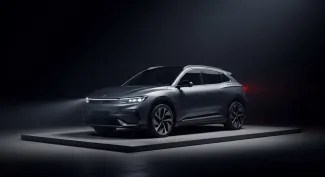
The European electric vehicle landscape is undergoing a quiet but profound transformation. As legacy automakers race to close the cost and development gap with agile Chinese rivals, some are choosing a path that would have seemed unthinkable just a few years ago: embracing Chinese technology as the foundation for their own models. The latest example comes from Opel, which is reportedly developing its next compact electric SUV around the electric architecture and battery systems of China's Leapmotor.
This is not a low-volume experiment or a badge-engineered import. If approved, the new Opel SUV would be developed in Germany, potentially assembled at Stellantis' Zaragoza plant in Spain, and aimed squarely at the heart of Europe's most competitive EV segment. What makes this project remarkable is speed: the development cycle is expected to take under two years, a fraction of the four to five years typically required for a clean-sheet European EV programme. That acceleration is possible only because Leapmotor's proven LEAP 3.0 platform — complete with cell-to-chassis battery integration — provides a ready-made technological backbone.
The numbers behind Leapmotor's existing European offering, the B05 hatchback, illustrate why Stellantis sees this partnership as strategically vital. Priced from €26,900 in Italy before incentives, the B05 undercuts the Volkswagen ID.3 by nearly €10,000 and Stellantis' own Peugeot E-308 by over €13,000. It delivers up to 482 kilometres of WLTP range from a 67.1 kWh battery, supports 174 kW DC fast charging, and comes generously equipped with a 14.6-inch touchscreen, 360-degree camera, and a full ADAS suite. By building the B05 at its Zaragoza facility, Stellantis sidesteps the EU's steep tariffs on Chinese-built EVs while preserving aggressive pricing.
For European consumers, the implications are significant. The Opel SUV will look unmistakably German, with the brand's signature design language and chassis tuning performed in Germany, but its most expensive and complex components — the battery pack, electric motors, and core electronic architecture — will likely originate from China. This mirrors patterns already visible elsewhere: the electric Mini Cooper is built in China through a BMW-Great Wall Motor joint venture, while Volvo's EX30 rides on Geely's platform. Yet the Opel project goes further, representing a mainstream European legacy brand staking its future compact SUV on Chinese underpinnings.
The strategic calculus for Stellantis is clear. The group has struggled to turn a profit on its European EVs amid brutal price competition and soaring development costs. By leveraging Leapmotor's technology, it can slash both development expenditure and time-to-market. Reuters recently reported that Stellantis plans to concentrate resources on Jeep and Ram in the United States and Peugeot and Fiat in Europe, while other brands increasingly rely on shared technology. The recent decision to cut 650 Opel engineering positions in Germany, followed by the announcement that Opel's next EV would use Chinese architecture, underscores this shift toward technology sharing rather than in-house development.
However, the move is not without risks. European regulators and politicians have grown increasingly wary of Chinese influence over the continent's automotive supply chain. The EU's ongoing anti-subsidy investigation into Chinese EVs and the resulting tariffs reflect broader concerns about dependency. While local assembly in Spain helps circumvent import duties, the fundamental technology transfer raises questions about Europe's long-term competitiveness. If European brands become little more than design studios and assembly wrappers for Chinese engineering, the continent risks losing the deep manufacturing expertise that has defined its automotive industry for a century.
For now, the Opel-Leapmotor project appears to be just the beginning. Industry observers speculate that Peugeot and Fiat could follow with their own Leapmotor-based models, turning the Chinese brand's platform into a shared foundation across multiple Stellantis nameplates. Whether European buyers embrace these technologically hybrid vehicles may ultimately determine how far this trend extends — and whether the future of Europe's electric transition will be written in Brussels and Rüsselsheim, or increasingly dictated by developments in Hangzhou and Shenzhen.
What is Leapmotor and why is Stellantis partnering with it?
Leapmotor is a Chinese electric vehicle manufacturer known for affordable, technology-rich EVs. Stellantis acquired a controlling 51% stake in the company to gain access to cost-efficient EV platforms and battery technology, enabling faster and cheaper development of electric models across its European brands.
Will the new Opel SUV be built in Europe or imported from China?
Opel is considering building the new compact SUV at Stellantis' Zaragoza plant in Spain, following the same local assembly strategy used for the Leapmotor B05. This approach allows the vehicle to avoid EU tariffs on Chinese-built EVs while keeping production within Europe.
Does this mean future European EVs will rely on Chinese technology?
The trend is growing but not universal. Several European brands already use Chinese platforms or production partnerships, including the electric Mini Cooper and Volvo EX30. However, major players like Volkswagen, BMW, and Mercedes-Benz continue to develop proprietary EV architectures, suggesting the market will feature a mix of in-house and partnered technology.
Source: https://insideevs.com/news/795383/opel-leapmotor-electric-suv-europe/