
Listen to this article:
The North American Offensive: Seven Models Under $40,000
The headline-grabbing numbers from Stellantis' Investor Day presentation target the US market directly. The group confirmed that seven new Jeep, Ram, Dodge, Chrysler, and Fiat vehicles will carry sticker prices below $40,000, and two will dip under the $30,000 threshold. Leading the charge are two Chrysler "Value By Design" models — the Airflow and Arrow — both starting below $30,000. The plan also confirms the long-awaited Jeep Recon EV, billed as the first and only fully electric Trail Rated SUV, alongside a new Cherokee, the Wrangler Scrambler pickup, and SRT performance variants across multiple nameplates.
On the Ram side, the Rampage and Dakota pickups will return, joined by the Ramcharger, the brand's first extended-range electric vehicle (EREV). Dodge gets a new GLH and a second model, both with SRT versions. Stellantis is betting that flooding the North American market with affordable product — 11 all-new vehicles, expanding market coverage by 50% — will drive a targeted 25% revenue increase and an adjusted operating income margin of 8–10% in the region. Sixty percent of the €36 billion earmarked for brand and product investments flows to North America, underscoring where management sees the richest near-term returns.
Europe's E-Car: A €15,000 Answer to BYD
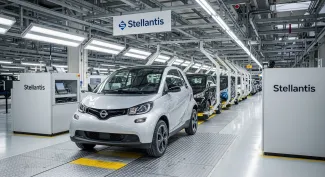
For European readers, the most significant announcement is not happening in Michigan at all — it is unfolding in Pomigliano d'Arco, Italy. Stellantis confirmed that its "groundbreaking" E-Car project — standing for European, Emotional, Electric, and Environmental friendliness — will begin production at the Pomigliano plant in 2028. A source close to the matter told Reuters the entry-level EV will start at around €15,000, placing it squarely in competition with the Dacia Spring (€16,900), the upcoming VW ID. EVERY1 (€20,000), and the flood of low-cost Chinese models arriving from BYD and Leapmotor.
CEO Antonio Filosa framed the E-Car as a direct response to European customer demand: "Our customers are calling for a revival of small, stylish vehicles, proudly produced in Europe, which are also affordable and environmentally friendly." The Pomigliano plant, which currently builds the Fiat Panda, should approach full employment once E-Car production scales. This matters acutely in a European context where Stellantis is simultaneously planning to cut capacity by more than 800,000 units across the continent — repurposing plants in Poissy, France, and leveraging partnership capacity in Madrid, Zaragoza, and Rennes. The sobering arithmetic: European capacity utilization sits at just 60% today; FaSTLAne 2030 targets 80% by 2030.
STLA One: The Platform That Underpins Everything
The technical backbone of FaSTLAne 2030 is the all-new STLA One platform, a modular, multi-energy architecture designed to accommodate battery-electric, hybrid, and internal combustion powertrains without the cost penalties that typically plague flexible platforms. Stellantis chief engineering officer Ned Curic described it as "a clear example of a truly modular strategy, giving us the flexibility of a multi-energy platform without carrying inefficiencies from one propulsion system to another."
The numbers are aggressive: by switching to lithium iron phosphate (LFP) batteries and a simplified cell-to-body design that integrates the battery directly into the vehicle's structural frame, Stellantis targets a 20% cost reduction versus current platforms. The architecture is 800-volt capable for faster charging, and by 2030, the company expects 50% of global annual volumes — across all powertrain types — to roll off just three global platforms. Complementing the hardware is a new software stack launching in 2027: STLA Brain (central compute and software architecture), STLA SmartCockpit (AI-powered infotainment), and STLA AutoDrive (scalable autonomous driving). By 2030, 35% of vehicles sold globally will carry at least one of these technologies; the figure hits 70% by 2035.
The Partnership Web: Leapmotor, Dongfeng, JLR, and Tata
Stellantis is conspicuously not trying to fund this transformation alone. The plan leans heavily on a growing network of strategic partnerships. The 51%-owned Leapmotor International joint venture will deepen — the two companies intend to share purchasing, pool supplier bases, and jointly use manufacturing capacity at the Madrid and Zaragoza plants in Spain, aligned with upcoming Made-in-Europe requirements. In a separate deal, Stellantis is creating a 51%-owned European joint venture with China's Dongfeng to collaborate on distribution, engineering, sourcing, and capacity sharing at the Rennes plant in France. Two Peugeot and two Jeep-branded new-energy vehicles will emerge from the DPCA joint venture in China for export from 2027.
The partnership strategy extends beyond Chinese automakers. Stellantis confirmed it is exploring co-development synergies with Jaguar Land Rover in the United States, while technology collaborations with Qualcomm, NVIDIA, Wayve, Applied Intuition, Mistral AI, and CATL will supply the computing, AI, and battery building blocks for the STLA tech stack. This open-ecosystem approach marks a deliberate departure from the fully in-house development model that has strained the balance sheets of several rival automakers.
What FaSTLAne 2030 Means for the European EV Landscape
Strip away the investor-day pageantry and the central message for Europe is one of disciplined consolidation paired with targeted ambition. Stellantis is narrowing its brand focus to four global flagships — Jeep, Ram, Peugeot, and FIAT — while repositioning Citroën, Opel, and Alfa Romeo as regional specialists and demoting DS and Lancia to specialty brands. The Enlarged Europe region is targeting a modest 15% revenue increase and a 3–5% AOI margin, figures that reflect management's sober assessment of the continent's fiercely competitive and margin-thin mass market.
Yet the E-Car project, combined with the Leapmotor and Dongfeng manufacturing partnerships, represents something genuinely new: a European legacy automaker openly embracing Chinese industrial cooperation to accelerate its affordable EV timeline. Whether Stellantis can deliver a €15,000 EV from Pomigliano before BYD locks in European buyers with its own factory footprint — the company is actively negotiating to take over underutilized Stellantis plants — is the defining competitive question hanging over FaSTLAne 2030. The plan's 24-month vehicle development target (down from 40 months today) and its €6 billion annual cost reduction programme suggest management understands the urgency. Execution, as always, will determine whether the slide deck translates into cars customers actually want to buy.
When will the Stellantis €15,000 electric car be available?
The first E-Car model is scheduled to begin production at Stellantis' Pomigliano d'Arco plant in Italy in 2028. It will target a starting price around €15,000, though final pricing has not been confirmed by the company.
Which Stellantis brands are being prioritised globally?
Stellantis is concentrating investment on four global brands with the highest profitability potential: Jeep, Ram, Peugeot, and FIAT. Approximately 70% of brand and product investment will go to these four marques, alongside the Pro One commercial vehicles unit. Citroën, Opel, Alfa Romeo, Chrysler, and Dodge will operate as regional brands with increased distinctiveness in their respective markets.
Will the new Jeep Recon EV be sold in Europe?
Stellantis has not yet confirmed European availability for the Jeep Recon EV, which is set to launch later this year. Given that Jeep is one of the company's four designated global brands, a European introduction appears plausible, though the Recon is being positioned primarily for the North American market in its initial launch phase.
Source: https://electrek.co/2026/05/21/jeep-ram-more-affordable-prices-under-40000/