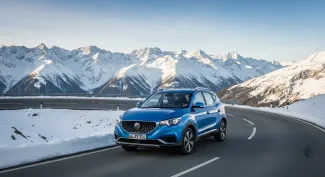
MG ZS EV: two generations, two very different cars
MG is owned by China's SAIC Motor — one of the world's largest EV manufacturers — and markets itself aggressively on value across Europe. The ZS EV is a compact SUV measuring 4,323 mm in length with a 2,581 mm wheelbase, slotting into the B-SUV segment alongside the Opel Mokka Electric and Peugeot e-2008. Boot space is 470 litres — more than a Hyundai Kona Electric and on par with the Kia Niro EV. That is a genuine family-car number.
The first generation arrived in 2019 with a 44.5 kWh battery, a 105 kW front-mounted motor, and a WLTP range of just 263 km. In 2022, the facelift overhauled the car — new front-end design, a dramatically upgraded infotainment system, and most importantly, a proper powertrain update. Let's look at what changed.
| Parameter | MG ZS EV (2019–2021) | MG ZS EV facelift (2022+) |
|---|---|---|
| Powertrain | Front-wheel drive | Front-wheel drive |
| Max. power | 105 kW (143 hp) | 130 kW (177 hp) |
| Torque | 353 Nm | 280 Nm |
| Battery | 44.5 kWh (NMC) | 51 kWh / 72 kWh (NMC) |
| Range (WLTP) | 263 km | 320 km / 440 km |
| DC charging (max) | 50 kW | up to 94 kW |
| AC charging (max) | 7 kW (single-phase) | 11 kW (three-phase) |
| Acceleration 0–100 km/h | 8.5 s | 8.2 s |
| Top speed | 175 km/h | 175 km/h |
| Weight | 1,502 kg | 1,620 kg |
| Warranty (factory) | 7 years / 150,000 km | 7 years / 150,000 km |
| Approx. used price | €12,000–17,000 | €19,000+ (SR) / €23,000+ (LR) |
Charging: here's where the two cars split completely
The first-generation ZS EV's biggest weakness? Slow charging. A maximum of 50 kW at a DC fast charger feels archaic today — going from 10 to 80 % takes around 45–50 minutes. Worse still, the on-board charger is only single-phase 7 kW. Even if you have an 11 kW wallbox at home, the old MG will only pull seven. A full charge from zero takes over 6 hours — fine overnight, but painfully slow if you need a top-up during the day.
The facelift fixed this. Standard equipment now includes a three-phase 11 kW on-board charger, while DC fast-charging jumped to 94 kW. In practice, that means 10 to 80 % in roughly 30–35 minutes on the Long Range version. The difference is night and day — a car you'd once be waiting for at every second charging stop becomes a fully viable long-distance companion.
The charging port on both generations is located behind the front grille, under the MG badge. It's a clean design choice, but it does mean you must park nose-first at most charging stations. On the plus side, the central front placement means the ZS EV never blocks a second stall at Tesla Superchargers — a real-world advantage if you use the increasingly open Supercharger network across Europe.
Range: 263 vs 440 km — an entire journey's difference
The first-generation car with its 44.5 kWh battery promises 263 km WLTP. In real-world driving, expect 200–230 km in summer and 140–170 km in winter on the motorway. A trip from Munich to Berlin (around 600 km) would require at least two — possibly three — charging stops.
The facelift Long Range with its 72 kWh battery delivers a WLTP figure of 440 km. Realistically, you'll cover 350–380 km in summer and roughly 260–300 km in winter. The standard-range facelift (51 kWh) sits in between with a WLTP of 320 km, translating to around 250 km of real summer range. For anyone who regularly drives between major European cities, the Long Range is the clear pick.
What about efficiency? Based on tests by Carwow, Parkers, and our own experience, the ZS EV returns 16–19 kWh/100 km in mixed driving. On the motorway at 130 km/h, expect 20–22 kWh; in city traffic, it can drop below 15 kWh.
What owners praise
Across owner forums and long-term reviews from the UK, Norway, and the Netherlands, four positives come up repeatedly:
Value for money. When the ZS EV launched at roughly €30,000 before incentives, it offered more interior space than a Nissan Leaf and a significantly more modern EV platform than a used Renault Zoe at a comparable price. Today, used examples start around €12,000 — a price point where almost nothing else offers this combination of space, range, and remaining warranty.
Space and practicality. The 470-litre boot is above average for the B-SUV segment. Rear knee room is decent, and while the battery pack raises the floor slightly, two child seats fit without drama. For a family of four, this is a fully capable car — not a compromised city runabout.
Comfortable ride. The MG ZS EV is no sports car, and it doesn't pretend to be. The suspension is tuned soft, the steering is light and accurate, and the overall experience on motorways and country roads is relaxed. Tyre noise at high speeds is noticeable, but the cabin remains quiet otherwise, even in older examples.
Seven-year warranty. MG provides a factory warranty of 7 years or 150,000 km, which transfers to subsequent owners. Many used ZS EVs on the market are therefore still covered — a significant peace-of-mind factor when buying a second-hand EV from a relatively young brand.
What to watch out for: common issues
Research from owner forums and reviews — including data from Carwow and Parkers — highlights several recurring themes:
Infotainment on early cars. The pre-facelift has an 8-inch display with sluggish response and an older version of the iSmart system. Apple CarPlay and Android Auto are wired only, and the system occasionally freezes. The facelift received a 10.1-inch screen with noticeably faster graphics and wireless smartphone mirroring — the difference is substantial.
Hard plastics in the cabin. MG saved money on materials. The dashboard and door cards are made of hard plastics that can develop creaks after a few years. It won't stop the car from working, but don't expect a premium feel. The facelift improved things with leatherette upholstery, but the underlying materials remain the same.
Surface corrosion. Early production cars (2019–2020) have drawn complaints about surface rust on underbody components and the exhaust cover — mostly a cosmetic concern rather than a structural one. Overall anti-corrosion protection is average for this price segment. Check the underbody before buying.
Missing features. Neither generation supports over-the-air (OTA) software updates — any firmware upgrade requires a dealer visit. An electric tailgate is entirely absent; the rear hatch is heavy, which matters particularly for shorter drivers. Battery pre-heating is available on the facelift but must be activated manually, unlike the automatic pre-conditioning found on more expensive EVs.
How it stacks up against the competition
If you're shopping for a used EV in a similar budget range, the ZS EV's main alternatives are:
Hyundai Kona Electric (from €16,000 used): Longer range (up to 484 km WLTP on the 64 kWh version), better efficiency, but a smaller boot (332 litres) and tighter rear seats. DC charging up to 100 kW on newer versions. Subjectively more engaging to drive.
Nissan Leaf (from €10,000 used): The cheapest ticket into EV ownership, but with compromises — CHAdeMO fast charging is being phased out across Europe, and the passively cooled battery degrades faster. Range spans 270–385 km WLTP depending on the version. Better suited to urban use than cross-country trips.
VW ID.3 (from €20,000 used): A more modern platform, superior driving dynamics, and up to 550 km WLTP range on the Pro S. But for the price of a used ID.3, you can get a facelifted MG ZS EV Long Range with more equipment and a larger boot.
Renault Zoe (from €11,000 used): An urban specialist — smaller, nimbler, with up to 395 km WLTP. But it's tight for a family: 338-litre boot and cramped rear seats. The 22 kW AC charging capability is a genuine strength for those who charge at public AC points.
Our verdict: which one should you buy?
If your budget is tight at €12,000–15,000 and you mainly drive around town and the surrounding area, the first-generation MG ZS EV still makes sense. For that money, you get a spacious family EV that may still be under warranty. You will have to accept slow charging, shorter range, and a dated infotainment system. If you charge at home overnight and only occasionally take longer trips, these are manageable trade-offs.
But if you can stretch your budget by another €6,000–8,000, go for the facelift with the Long Range battery (72 kWh). Three reasons: a real-world range comfortably beyond 350 km makes cross-border trips viable, the 11 kW three-phase AC charger fills the battery overnight, and 94 kW DC charging cuts the coffee-break wait to a bearable half-hour. Add in the improved infotainment, sharper exterior design, and vastly superior daily usability, and the extra spend pays for itself in reduced charging frustration.
The mid-range Standard Range (51 kWh) facelift is a compromise we struggle to recommend — the price gap to the Long Range is smaller than the real-world benefit of the larger battery.
How can I tell a pre-facelift MG ZS EV from the updated version?
The easiest giveaway is the front end. The pre-facelift has a traditional radiator grille with the MG badge centred on it — the charging port hides behind it. The 2022 facelift has a closed, aerodynamic front panel (often called a "grille-less" design), slimmer LED headlights, and the MG badge sits lower on the nose. However, the charging port remains behind the front badge area on both versions. Also check the infotainment screen: 8 inches on the old car, 10.1 inches on the facelift.
Does the MG ZS EV battery degrade quickly?
The NMC battery with active liquid cooling holds up well over time. Owner reports from forums — particularly in the UK and Norway — suggest typical degradation of 5–8 % after 80,000–100,000 km, meaning over 90 % of original capacity remains. MG's battery warranty covers 7 years or 150,000 km with a guaranteed minimum of 70 % capacity. We strongly recommend a battery health diagnostic before purchasing any used EV.
Does the MG ZS EV have a heat pump?
Only from the facelift onward (2022+). The pre-facelift uses resistive electric heating, which is significantly more power-hungry and takes a bigger bite out of winter range. The heat pump is standard equipment on the facelift, though it's sometimes omitted from used-car listings. Expect 20–25 % winter range loss on the older car, versus around 15–18 % on the facelift with the heat pump.