
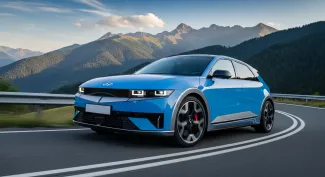
A Price That Demands Attention
When the IONIQ 5 N launched, it was celebrated for its engineering audacity — 641 hp, an 800-volt architecture, and driving dynamics that made seasoned journalists question whether electric cars could ever really be as fun as ICE performance cars. The answer was a resounding yes. But its price kept it out of reach for many.
For 2026, Hyundai has made a decisive move. The new starting price of $61,500 — down from $67,800 — brings the IONIQ 5 N within striking distance of the Tesla Model Y Performance, which starts at $59,630 in the US. That is a direct competitive signal, and it's a smart one: the IONIQ 5 N offers dramatically more driver engagement, a more powerful drivetrain, and a far deeper bag of performance tricks than any Tesla currently on sale.
For European buyers, the price revision sends an important signal too. The IONIQ 5 N arrived in Europe priced from around €69,900, competing with the Porsche Taycan entry grades and the BMW i4 M50. A European pricing update has not yet been confirmed, but given Hyundai's pattern of aligning global markets, adjustments are widely expected.
641 Horsepower, 800 Volts, 18 Minutes to 80%
The headline numbers remain unchanged from the previous model year — and they don't need to change. The IONIQ 5 N produces 641 horsepower through its dual-motor all-wheel-drive system, with an electronic limited-slip differential on the rear axle that enables the kind of precise torque vectoring that was previously only possible in purpose-built sports cars.
The 800-volt battery architecture enables 10-to-80% charging in approximately 18 minutes with a 350 kW DC fast charger. That is exceptionally fast for a car of this class, and it's one of the most compelling arguments for the IONIQ 5 N over European competitors that still rely on 400-volt systems.
EPA-estimated range stands at 221 miles (355 km) — a figure that reflects the compromise of packing 641 horsepower into a compact electric SUV-inspired body. Real-world range will vary significantly based on driving style; engage the N Grin Boost and the battery depletes faster, but the grin on your face grows proportionally.
NACS Port: The Practical Upgrade Everyone Wanted
Perhaps the most practically significant change for 2026 is the integration of a native NACS (North American Charging Standard) port — the same connector used by Tesla Superchargers across North America. Hyundai includes adapters for DC fast charging, AC charging, and a dual-voltage mobile charger, ensuring compatibility across the existing charging infrastructure.
For European drivers, NACS adoption in the US market is part of a broader global standardisation shift that will simplify charging logistics for EV owners. Hyundai Europe already uses CCS2 connectors, which remain the standard on the continent, but the move to NACS in North America demonstrates Hyundai's commitment to maximising charging convenience wherever the car is sold.
Ten Stages of Controlled Chaos: The N Drift Optimizer
The 2026 IONIQ 5 N's most headline-grabbing new feature is the expanded N Drift Optimizer, which now offers ten selectable stages instead of the previous single-mode system. This gives drivers granular control over how aggressively the rear wheels can break traction — from light oversteer for spirited road use to full-commitment slide for track days and closed circuits.
Combined with the N e-Shift technology — which simulates the behaviour of an eight-speed dual-clutch transmission, complete with artificial gear changes transmitted through the steering wheel paddles and the seat — the IONIQ 5 N remains one of the few electric cars that actively rewards driver skill. The N Active Sound+ system adds a layer of acoustic theatre, synthesising transmission sounds that correspond to the virtual gear selected.
These features are deliberately polarising. Purists will dismiss the simulated gearshifts as unnecessary theatre; enthusiasts who have driven the car will tell you they add genuine engagement in a category that can feel sterile. The ten-stage Drift Optimizer, however, is unambiguously useful — it allows precise calibration to different surfaces, weather conditions, and skill levels.
Comfort and Safety Additions Round Out the Package
Hyundai hasn't focused exclusively on performance for 2026. The Forward Attention Warning in-cabin camera system — which monitors driver attentiveness — is now standard equipment across the line. Automatic rear window operation has been added, addressing a minor but persistent complaint from owners. And a new Performance Blue Pearl exterior colour joins the palette, giving the car a visually distinctive option alongside the existing choices.
These additions reflect Hyundai's maturation as a performance EV manufacturer. The original IONIQ 5 N was so focused on driving dynamics that some everyday conveniences felt like afterthoughts. The 2026 model corrects that balance without softening the car's essential character.
Where It Sits in the Market
The performance electric segment is becoming genuinely competitive. The BMW i4 M50, the Porsche Taycan base model, and the Mercedes-AMG EQE all occupy similar territory — though at considerably higher price points. The upcoming Mercedes-AMG CLA 45 Electric, revealed with three axial-flux motors and 500 kW of power, will eventually raise the stakes further, but it's not yet on sale.
At $61,500 in the US — and with the performance credentials of a car costing considerably more — the 2026 IONIQ 5 N is arguably the best value proposition in the high-performance EV segment. Its driving dynamics have consistently been praised as class-leading, and the 2026 revisions address the areas where the original fell slightly short.
For European buyers considering a performance EV in the €60,000–€75,000 range, the IONIQ 5 N deserves serious consideration. It is not the most refined, it is not the quietest, and it does not have the longest range. What it offers instead is something rarer: genuine driving pleasure, delivered electrically, at a price that doesn't require a sports car budget.
What is the 2026 Hyundai IONIQ 5 N's charging speed?
The 2026 IONIQ 5 N uses an 800-volt electrical architecture that enables 10-to-80% charging in approximately 18 minutes when connected to a 350 kW DC fast charger. This is among the fastest charging speeds available in any production electric vehicle today.
Does the 2026 IONIQ 5 N have a NACS port in Europe?
The NACS port is being introduced on the 2026 model in North America. European versions of the IONIQ 5 N continue to use the CCS2 connector, which is the standard for public fast charging across the EU and UK charging networks.
How does the N Drift Optimizer work?
The N Drift Optimizer controls how much rear-wheel slip is permitted before the electronic systems intervene. The 2026 model expands this from a single mode to ten selectable stages, allowing drivers to dial in exactly how much oversteer they want — from mild for wet roads to maximum for track conditions. It works in conjunction with the rear electronic limited-slip differential for precise handling control.
Source: https://insideevs.com/news/801814/2026-hyundai-ioniq-5-n-price-specs-official/