Listen to this article:
A Historic Name Reborn in a New Era
When Land Rover retired the original Freelander nameplate in 2014, few would have predicted it would return over a decade later as a range-extended electric SUV built in China. Yet the Freelander 8 First Edition does exactly that — carrying both the legacy of a beloved British off-road brand and the technological ambitions of one of China's most dynamic automotive partnerships.
The joint venture between Chery Automotive and Jaguar Land Rover (JLR) has invested 12 billion yuan (approximately $1.78 billion USD) in manufacturing infrastructure for this venture. That is not a small bet. It signals genuine commitment to producing vehicles that can compete not just on price, but on capability, technology, and premium appeal.
The EREV Architecture: Why 800V Matters
The Freelander 8 rides on an 800V high-voltage range-extended electric vehicle (EREV) architecture — the same electrical standard increasingly adopted by premium Chinese EVs and now spreading to European models. Higher voltage means faster charging, lower heat generation, and more efficient energy transfer across the drivetrain.
At its core is a 60.331 kWh battery system co-developed with CATL, one of the world's leading battery manufacturers. The battery supports 6C charging, unlocking a peak charging capacity of 350 kW — a figure that places it firmly in the ultra-rapid-charge category. For a large, capability-focused SUV, that is a significant technical achievement.
When the battery runs low, a 1.5-litre turbocharged range extender producing 115 kW takes over, eliminating range anxiety on longer journeys without the full complexity of a traditional plug-in hybrid drivetrain. The certified pure electric range of 221 km is sufficient to cover most daily urban and suburban driving patterns without the engine ever starting.
Off-Road Credentials: More Than a Badge
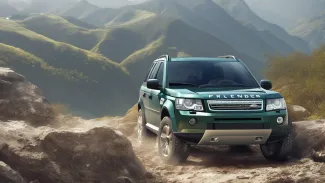
Despite its electrified heart, the Freelander 8 First Edition takes its off-road DNA seriously. The chassis features a closed dual-chamber air suspension system — the kind of hardware found on far more expensive rivals — and an impressive three-lock system: a front mechanical differential lock, rear electronic limited-slip differential, and a virtual centre lock.
Tying everything together is the i-ATS (Intelligent All-Terrain System), co-tuned with Huawei software to adapt automatically to different surface conditions. For a vehicle with a gross weight of 3,495 kg, managing torque distribution intelligently across all four corners is not just a luxury — it is a safety imperative.
Huawei Inside: The Technology Partnership Powering Intelligence
Perhaps the most revealing aspect of the Freelander 8's specification sheet is its reliance on Huawei's Qiankun ADS 5 intelligent driving assistance platform — the same system deployed in several of China's most technologically advanced EVs. This places the Freelander 8 in a growing ecosystem of vehicles that use Huawei's software and sensor stacks as a competitive differentiator.
The hardware backing this system is equally impressive: a Qualcomm Snapdragon 8397 flagship computing chip and a 896-line roof-mounted LiDAR sensor. High-resolution LiDAR at this specification level is still rare even in premium European vehicles, making the Freelander 8 genuinely advanced by global standards.
Six Seats, Three Variants, and Early Sales Momentum
The Freelander 8 First Edition is available in a six-seat configuration across three trim levels: Pro, Max, and Max+. The "First Edition" designation suggests a launch-focused variant designed to attract early adopters and generate brand momentum.
The sales data from the early months is cautiously encouraging. Cumulative deliveries through May 2026 reached 3,976 units, with May alone accounting for 997 vehicles. While these numbers are modest by Chinese market standards — where monthly volumes of tens of thousands define market leadership — they represent a genuine start for a brand that only made its first public physical appearance in June 2026, following an initial brand presentation in March.
What It Means for the Global EV Landscape
The Freelander 8 is one of the clearest examples yet of how Western automotive brands are finding new life through Chinese partnerships. JLR brings the heritage, the off-road philosophy, and the premium positioning. Chery brings the manufacturing scale, the supply chain relationships, and the technology access — including the CATL battery chemistry and Huawei's intelligent driving stack.
For European observers, this raises an important question: will the Freelander 8 eventually cross the border into Western markets? JLR has not confirmed any such plans, and the current model is deeply optimised for Chinese regulatory standards and consumer expectations. But the 800V architecture, the CATL battery, and the Huawei ADS 5 platform are all globally relevant technologies. If trade conditions allow, a European version is not unimaginable.
What is clear is that the EREV format — long championed by Chinese brands like Li Auto — is proving increasingly compelling for large SUVs. The combination of meaningful pure-electric range for everyday use and an internal combustion safety net for longer trips addresses the real-world concerns of buyers who are not yet ready to commit fully to BEV. The Freelander 8's 221 km electric range is enough to make the range extender genuinely optional for most owners, rather than a constant crutch.
What is the difference between an EREV and a standard plug-in hybrid?
In an EREV (Range-Extended Electric Vehicle), the internal combustion engine does not directly drive the wheels — it acts solely as a generator to recharge the battery. This means the vehicle always drives electrically, unlike a conventional PHEV where the petrol engine can also power the drivetrain directly. The result is a driving experience that feels more like a pure EV, with the combustion engine serving only as a backup range generator.
Is the Freelander 8 available in Europe?
As of mid-2026, the Freelander 8 First Edition is exclusively sold in China through the Chery-JLR joint venture. JLR has not announced plans to bring it to European markets, though the platform uses technologies — including CATL batteries and Huawei ADAS — that are increasingly global in scope. Any European launch would also face regulatory and trade considerations given current EU-China tariff dynamics.
How does the Freelander 8's charging speed compare to other premium EVs?
The Freelander 8 supports 6C charging on its 60 kWh CATL battery, unlocking a peak charge rate of 350 kW. For comparison, most premium European EVs currently top out at 200–270 kW. This places the Freelander 8 among the fastest-charging vehicles available in its segment, though realising those speeds requires access to compatible 800V ultra-rapid charging infrastructure.