
Listen to this article:
A Distributed Architecture Built for Scale
The centrepiece of Autel's European offering is a distributed charging architecture that splits power delivery into centralised cabinets and remote dispensers — a design that allows operators to scale sites without repeatedly upgrading grid connections. The MaxiCharger DS600L serves as the system's power backbone, a liquid-cooled cabinet that can be clustered to deliver up to 3 MW of charging output. Its in-house developed liquid-cooled power modules claim over 97 percent efficiency, and critically, the modules are hot-swappable — meaning maintenance can be performed without taking the entire site offline. This is not a trivial feature. For a motorway service station serving hundreds of EVs daily, even 30 minutes of downtime can translate into a queue of frustrated drivers. Autel's insistence on modular, field-serviceable components speaks directly to the operational realities that European CPOs are now grappling with, particularly as the EU's Alternative Fuels Infrastructure Regulation (AFIR) mandates fast chargers every 60 kilometres along the TEN-T core network.Dynamic Power Allocation and Fleet-Ready Solutions
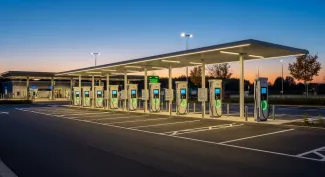
Paired with the DS600L, the MaxiCharger DT300 is a rail-mounted dispenser system capable of feeding up to 10 vehicles simultaneously from a single cabinet. What sets it apart is dynamic power allocation: rather than assigning fixed kilowatt ratings to each port, the system monitors real-time demand across all connected vehicles and distributes power accordingly. When a Porsche Taycan pulling 320 kW is sitting next to a Renault Zoe that maxes out at 50 kW, the system intelligently shifts the surplus to where it is needed. For operators targeting faster, lower-cost deployment — think supermarket car parks, hotel forecourts, or fleet depots — Autel has introduced the MaxiCharger DH120. This compact all-in-one unit is designed for destination and fleet charging scenarios where installation complexity and civil works are the main cost drivers. Autel claims the system supports overall uptime of up to 98 percent, a figure that matches what leading European networks such as Fastned and Ionity publicly report.Software: The Invisible Backbone
Hardware specifications alone no longer differentiate charging providers — the software layer increasingly determines whether a network is profitable or bleeding money. Autel's One-Click Site Commissioning tool combines cloud-based pre-configuration with guided on-site setup, aiming to reduce the time between delivery and first charge from days to hours. For multi-unit installations — a shopping centre with 20 AC wallboxes, for instance — this can meaningfully compress project timelines. On the maintenance side, the Tablet 2.0 diagnostic tool uses AI to run component-level fault detection across the entire Autel portfolio. Rather than sending a technician to physically inspect every charger, the tablet identifies the specific module — a failed power stage, a communication board, a cooling pump — and generates a repair plan before the engineer arrives on site. "As charging infrastructure scales, operators are facing growing challenges around uptime, system complexity, and long-term operational efficiency," said Andreas Lastei, VP Smart Energy at Autel Energy Europe.What This Means for the European Charging Landscape
Autel is not a household name in Europe the way ABB, Alpitronic, or Kempower are — but it is rapidly closing the gap. The company leverages its parent group's decades of experience in automotive diagnostics (the Shenzhen-based Autel Intelligent Technology Corp.) to build charging systems that are as serviceable as they are powerful. For European CPOs, this translates into an increasingly competitive supply landscape. The timing matters. Europe added roughly 150,000 public charging points in 2025 alone, according to industry estimates, but still falls short of the European Commission's target of 3.5 million by 2030. Grid congestion in countries like the Netherlands, Germany, and the UK is already forcing operators to invest in battery-buffered hubs and dynamic load management — precisely the kind of ecosystem Autel's integrated hardware-software stack is engineered to support. The broader question is whether Chinese-headquartered hardware suppliers can build the same trust with European fleet operators and municipal buyers that incumbent European brands enjoy. Autel's investment in a dedicated European subsidiary, localised software (available in French, German, Spanish, Italian, Dutch, and Norwegian), and a growing service partner network suggests the company understands that charging infrastructure is ultimately a local business, no matter how global the supply chain.What is a distributed charging architecture and why does it matter?
A distributed architecture separates the power conversion cabinet from the actual charging dispensers. The central cabinet handles AC-to-DC conversion and can feed multiple dispensers via DC bus. This reduces on-site AC infrastructure costs, simplifies grid connection, and allows operators to add more dispensers later without major electrical upgrades — a key advantage as EV adoption grows and sites expand.
How does Autel's offering compare to established European brands like Alpitronic or Kempower?
Alpitronic's HYC series and Kempower's satellite systems both use distributed architectures similar to Autel's DS600L and DT300. Autel differentiates with its in-house liquid-cooled modules, AI-driven diagnostic tools inherited from its automotive diagnostics business, and a growing but less established European service network. Price competitiveness is often cited by Autel's CPO clients as a key advantage, though long-term reliability data in European conditions is still accumulating.
Is Autel Energy a Chinese company?
Yes — Autel Energy is a division of Autel Intelligent Technology Corp., headquartered in Shenzhen, China. However, it operates a dedicated European subsidiary, Autel Energy Europe, with local offices, software localised in multiple European languages, and a regional service partner network. The company's EV chargers sold in Europe comply with EU standards including CE marking and OCPP communication protocols.