Listen to this article:
California Permits Put Lucid-Nuro-Uber Ahead in the Robotaxi Race
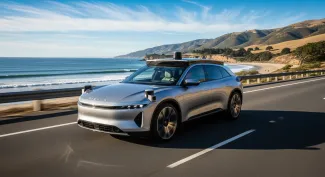
Nuro announced on May 8, 2026, that it had obtained a permit from the California Public Utilities Commission (CPUC) to test its Gravity-based robotaxis with a safety monitor on board, carrying passengers. Crucially, the company had already secured a separate permit from the California Department of Motor Vehicles (DMV) in April 2026, authorizing truly driverless testing on public roads without any human safety operator inside the vehicle. The permits cover Santa Clara and San Mateo counties, including operations in light rain and moderate fog, at speeds of up to 45 miles per hour (approximately 72 km/h). This dual regulatory clearance places the Lucid-Nuro-Uber consortium in rare company. Only a handful of operators have secured both permits, and Nuro is now positioned to gather real-world data in one of the world's most demanding autonomous vehicle testing environments.
The Tesla Gap: Promises Without Permits
The development is particularly striking when compared with Tesla's current position. Despite Elon Musk's repeated predictions that Tesla would operate a fully autonomous robotaxi network, the company's California operations remain limited. Tesla currently runs a Model Y-based robotaxi service in the state, but every ride includes a safety monitor behind the wheel. According to the California DMV, as of February 2026, Tesla had not even applied for the driverless testing permit that Nuro now holds, and a DMV spokesperson confirmed to InsideEVs that no new application had been received since then. Tesla has deployed what it calls "unsupervised" robotaxis in Austin, Texas, where regulatory requirements are significantly less stringent than in California, but the gap between marketing rhetoric and regulatory progress in the nation's largest EV market is becoming difficult to ignore.
A $500 Million Bet on Autonomous Ride-Hailing
The three-way partnership between Lucid, Nuro, and Uber represents one of the most significant commercial commitments to autonomous mobility in recent years. Uber is investing $500 million in Lucid and has committed to purchasing at least 35,000 vehicles for its autonomous fleet, comprising both Gravity SUVs and future electric vehicles based on Lucid's upcoming midsize platform. These vehicles will integrate Nuro's autonomous driving software and hardware stack, and riders will be able to summon them through the Uber app. The companies have set an ambitious target: commercial driverless ride-hailing operations in the San Francisco Bay Area by the end of 2026. If successful, this would mark the first large-scale deployment of premium electric robotaxis by a legacy ride-hailing platform, challenging Waymo's current dominance in the market.
Waymo's Lead and the Global Expansion Race
Waymo, Alphabet's autonomous driving subsidiary, remains the only company currently operating truly driverless paid rides at scale in California, serving hundreds of thousands of trips weekly across San Francisco, Los Angeles, Phoenix, and other US cities. However, the competitive landscape is intensifying rapidly. Beyond the Lucid-Nuro-Uber challenge, Amazon-backed Zoox and Chinese operator WeRide are also testing in California. Waymo itself is pushing beyond American borders, having begun specialist-supervised autonomous driving tests in London with Jaguar I-PACE vehicles. The company is actively mapping London boroughs and building service infrastructure, with commercial operations expected to follow. This international expansion underscores a critical reality: the technology being validated on California roads today is being prepared for deployment in European cities tomorrow.
What This Means for European Mobility
For European readers, the US robotaxi race is not a distant spectacle — it is a preview of the regulatory and technological challenges that will soon arrive on the continent. Europe currently has no large-scale commercial robotaxi service in operation, and regulatory frameworks remain fragmented across member states. While the EU has established broad vehicle safety and AI governance standards, individual countries and cities are still developing the specific permitting processes required for driverless commercial services. Waymo's London testing represents the most advanced European effort, but even that remains in the preliminary phase with safety specialists on board. The California experience offers a blueprint: rigorous permitting, incremental testing in varied weather conditions, and partnerships between technology providers, automakers, and mobility platforms. When European regulators eventually open the door to commercial robotaxi services, the companies that have already proven their systems in California's demanding environment will hold a decisive advantage. The question is not whether autonomous ride-hailing will come to Europe, but which alliance — and which underlying technology — will be ready to deploy it first.
What is the difference between the CPUC and DMV permits Nuro secured?
The California DMV permit authorizes Nuro to test its Lucid Gravity robotaxis on public roads without any human safety driver inside the vehicle. The separate CPUC permit allows the company to transport passengers during testing, though initially with a safety monitor present. Together, these permits create a regulatory pathway toward fully commercial driverless ride-hailing.
Why hasn't Tesla applied for a driverless testing permit in California?
Tesla has not publicly explained why it has not applied for California's driverless testing permit. The company operates its robotaxi service in California with safety monitors on board and has focused its unsupervised autonomous efforts on Austin, Texas, where regulatory hurdles are lower. Industry observers suggest Tesla may be pursuing a different regulatory strategy or that its Full Self-Driving system has not yet met California's specific safety validation requirements.
When could robotaxis like these become available in Europe?
No definitive timeline exists for European commercial robotaxi launches. Waymo is currently testing in London with safety specialists, but commercial operations have not begun. European regulators are developing frameworks for autonomous vehicle deployment, though progress varies by country. Industry analysts generally expect limited commercial robotaxi services to begin in select European cities between 2027 and 2028, contingent on regulatory approvals and technology validation.
Source: https://insideevs.com/news/795337/lucid-gravity-nuro-uber-california-permit/