
Listen to this article:
The landscape of electromobility in North America is shifting rapidly. With tens of thousands of Tesla Superchargers now accessible to various electric vehicle (EV) brands, the dream of a seamless, high-speed charging experience for all is becoming a reality. However, this transition has brought a practical, physical problem to the forefront: the charging cable is often not long enough to reach the charging ports of non-Tesla vehicles.
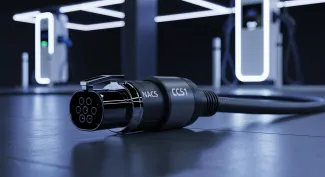
This issue frequently forces drivers into awkward positions, such as double-parking or occupying two stalls, just to ensure the cable can reach their vehicle's inlet. To address this, companies like Hansshow have developed specialized hardware, including their second-generation NACS to CCS1 extension cable. But does it actually work?
The Technical Challenge: NACS vs. CCS1
To understand why this cable is necessary, one must understand the current state of connector standards. In the United States, the industry is moving toward the North American Charging Standard (NACS), originally developed by Tesla. While most legacy EV manufacturers used the CCS1 (Combined Charging System Type 1), the shift toward NACS is nearly universal among major automakers.
When a non-Tesla vehicle—equipped with a CCS1 port—attempts to use a Tesla Supercharger, it requires an adapter. While adapters exist, they do not solve the problem of cable length. A Tesla V3 Supercharger is capable of delivering up to 250 kW of power, but if the vehicle's charging port is located on the opposite side of the car or too far from the stall, the cable simply cannot reach. The Hansshow extension cable, measuring approximately 8 feet (2.4 meters), was designed to bridge this specific gap.
Expert Review: Falling Short of Expectations
Charging expert Tom Moloughney recently put the production version of Hansshow’s second-generation cable to the test. Despite the manufacturer's claims that this version would rectify the flaws found in their first-generation product, the real-world results were disappointing.
In high-power DC fast-charging, the margin for error is incredibly slim. The communication between the vehicle, the adapter, and the charger (often referred to as the "handshake") must be flawless. If there is excessive resistance or a failure in the communication protocol, the charging session can fail, throttle to much lower speeds, or even pose safety risks due to heat buildup. Moloughney’s testing indicated that the Hansshow cable fell short of the reliability standards required for a seamless user experience, failing to provide the consistent, high-speed performance that Supercharger users expect.
Why Reliability is Hard to Achieve
Creating a reliable extension for DC fast charging is significantly more complex than creating one for AC home charging. When dealing with currents that can exceed 200 Amps, every millimeter of connection matters. Any impedance introduced by an extension cable can lead to:
- Voltage drops: Reducing the efficiency of the charge.
- Heat accumulation: Which can damage the connectors or the vehicle's port.
- Communication errors: Preventing the car and the charger from "talking" to each other, resulting in a failed session.
The European Context: A Different Standard
For readers in Europe, this specific hardware battle—NACS vs. CCS1—is largely a North American phenomenon. In the European market, the CCS2 (Combined Charging System Type 2) has become the undisputed standard for both AC and DC charging. While Tesla has adopted the CCS2 standard for its new European models, the interoperability issues seen in the US are less pronounced here because the hardware is unified.
However, the lesson for the European market remains relevant: as charging networks become more diverse and "open," the quality of third-party adapters and extensions will be critical. As we move toward more integrated energy grids and Vehicle-to-Grid (V2G) technologies, the hardware must be robust enough to handle high-frequency communication and high-power loads without failure.
For now, non-Tesla owners in the US looking to utilize the Supercharger network should remain cautious about third-party extension solutions that have not been rigorously vetted for high-speed DC performance.
Why can't I just use a standard CCS1 cable at a Tesla Supercharger?
Tesla Superchargers use the NACS connector. To use them, a non-Tesla vehicle must have an adapter that converts NACS to CCS1. Even with an adapter, the cable may be too short to reach your car's port, which is why extension cables are being developed.
Is the NACS standard coming to Europe?
It is highly unlikely. Europe has standardized on CCS2, which is used by almost all manufacturers and charging networks across the continent. The NACS transition is specific to the North American market.
Does using an extension cable slow down my charging speed?
It can. If the extension cable is not of high enough quality or has high electrical resistance, it can cause a voltage drop or communication errors, which may result in significantly slower charging speeds or a complete failure to charge.