Listen to this article:
The luxury automotive landscape is shifting rapidly, and Mercedes-Benz is making a decisive move to secure its position in the premium electric segment. The debut of the all-new electric C-Class represents more than just a new model; it is a demonstration of the brand's ability to integrate high-performance electric drivetrains into its most iconic nameplates. Unlike previous iterations that relied on hybrid technology, this C-Class is built from the ground up to leverage a dedicated electric architecture.
Advanced 800V Architecture and Charging Performance
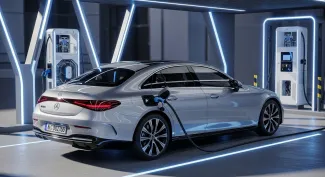
One of the most significant technical advancements in the new electric C-Class is its adoption of an 800V electrical architecture. While many current electric vehicles still rely on 400V systems, the move to 800V allows for much higher efficiency and, more importantly, significantly faster charging speeds. Mercedes-Benz has confirmed that the vehicle can support DC fast charging up to 360 kW.
In practical terms, this means drivers will spend considerably less time at charging stations. For long-distance travelers, this reduces the "charging anxiety" that often plagues EV adoption. The vehicle is equipped with a substantial 94 kWh battery pack, which provides the energy density required to achieve a WLTP range of 762 km. This range places the C-Class among the leaders in its class, capable of competing directly with the longest-range offerings from Tesla and BMW.
Performance and the Two-Speed Transmission
Performance remains a cornerstone of the C-Class identity. The electric variant utilizes two electric motors—one mounted on each axle—providing an all-wheel-drive configuration that delivers impressive power. Mercedes claims a 0-100 km/h acceleration time of just 4.0 seconds, ensuring that the driving experience remains engaging and spirited.
To optimize this power, Mercedes has implemented a 2-speed transmission housed within the rear axle. This is a sophisticated engineering choice; the first gear provides high torque for rapid off-the-line acceleration, while the second gear allows for higher efficiency and smoother cruising at highway speeds. This dual-purpose approach helps balance the conflicting needs of high-performance driving and long-range efficiency.
Precision Handling and Driving Dynamics
To ensure the C-Class remains a driver's car, Mercedes has integrated several advanced chassis technologies. The inclusion of rear-axle steering is a standout feature, significantly improving maneuverability by reducing the turning circle to just 11.2 metres. This makes the sedan much easier to navigate through tight urban environments, a common pain point for larger luxury vehicles.
Furthermore, the vehicle features air suspension with adaptive damping. This system allows the car to adjust its stiffness and ride height in real-time, providing a seamless transition between a composed, comfortable ride for long journeys and a firmer, more controlled setup for spirited driving. These features suggest that Mercedes is not merely replacing the internal combustion engine, but is actively refining the driving dynamics that the C-Class nameplate is known for.
Design and Market Strategy
Visually, the electric C-Class departs from the traditional three-box sedan shape, adopting a fastback-style design. This aerodynamic silhouette is not just an aesthetic choice; it is essential for reducing drag and maximizing the efficiency of the 94 kWh battery. By smoothing the airflow over the vehicle, Mercedes can push the range boundaries further.
The model shares its technical underpinnings with the GLC EV, indicating a modular approach to their electric platform. While the initial launch is slated for the United States market, the implications for the European market are profound. European luxury buyers, who demand high efficiency and premium technology, will likely see this as a direct competitor to the BMW i4 and the Tesla Model 3.
As Mercedes-Benz prepares for a global rollout, the focus will be on how this vehicle balances luxury, range, and charging speed. In a market increasingly crowded by both traditional luxury brands and new entrants from China, the electric C-Class must prove that it can deliver the quintessential Mercedes experience in a fully electric format.
How fast can the Mercedes electric C-Class charge?
Thanks to its 800V architecture, the C-Class supports DC fast charging up to 360 kW, allowing for much faster replenishment of the 94 kWh battery compared to standard 400V systems.
What is the driving range of the new C-Class EV?
The vehicle offers a WLTP-rated range of up to 762 km, making it one of the most capable long-range electric luxury sedans currently available.
Does the electric C-Class have all-wheel drive?
Yes, the model features two electric motors—one on each axle—providing an all-wheel-drive system that enables a 0-100 km/h time of 4.0 seconds.