
Listen to this article:
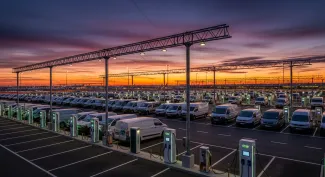
Zeem Solutions, a California-based fleet electrification specialist, has logged its 350,000th successful charging session at its LAX commercial depot. The milestone, announced at the ACT Expo in Las Vegas last week, makes the facility one of the highest-throughput commercial charging hubs in the United States — and offers a practical blueprint that European fleet operators are already studying closely.
What 350,000 sessions actually mean
In the first four months of 2026 alone, Zeem’s LAX site handled more than 75,000 charging sessions and dispensed over 3.2 million kWh of electricity. That is enough energy to power thousands of homes for a year — except every electron went directly into commercial vans, shuttle buses, and heavy-duty trucks serving one of the world’s busiest airports.
Rick Eckert, Vice President of Operations at Zeem Solutions, framed the achievement in terms that any fleet manager will understand. "What the 350,000-session milestone really measures is reliability at scale," he said. "Every one of those sessions represents a fleet vehicle that needed to get back on the road on time."
Zeem’s track record supports that claim. The company maintains a 98% charger uptime across its shared depots, achieved through a combination of preventive maintenance, 24/7 on-site staffing, and contracted charging slots that prevent the chaos of unmanaged queues.
Beyond plugging in: the full-service model
What distinguishes Zeem from a conventional charging network is its operational depth. The LAX depot does not simply provide plugs — it functions as an integrated fleet support centre. On-site valets rotate vehicles, perform visual inspections, and coordinate maintenance and repairs. Parking, security, and cleaning services are bundled into the same contract.
The facility accommodates a wide mix of vehicle classes on one site, from light-duty vans used by rideshare and delivery fleets to medium-duty trucks and Class 8 heavy rigs. That flexibility matters because modern logistics rarely relies on a single vehicle type. A depot that can charge a compact delivery van overnight and then handle a 40-tonne electric tractor unit is a depot built for real-world complexity.
Paul Gioupis, Zeem’s founder and CEO, says the lessons from 350,000 sessions are now shaping what the company calls Zeem 2.0 — a direct-to-site model where the same operational rigour is replicated at customer facilities rather than shared hubs. "Five years of operating commercial EV charging at scale has taught us what drives uptime, where execution matters most, and why reliability is non-negotiable," Gioupis explained.
The environmental ledger
The scale of Zeem’s LAX operation translates into measurable environmental results. The company estimates that its 350,000 charging sessions have avoided approximately 5.6 million kilograms of CO₂ emissions — equivalent to not burning more than 634,000 gallons of petrol or powering over 1,100 average American homes for a full year.
For European readers, the conversion is equally striking: 5.6 million kg of CO₂ is roughly the annual tailpipe output of 2,400 average diesel vans driven typical commercial mileage. In a continent where cities from London to Berlin are tightening low-emission zones, those savings are not abstract statistics — they represent cleaner air and quieter streets.
From LAX to SeaTac: the expansion plan
Zeem is not stopping at Los Angeles. The company has confirmed plans for new commercial charging depots to serve Seattle-Tacoma International Airport and the Port of Long Beach, with additional facilities under development nationwide. The geographic spread reflects growing demand from fleet operators that need charging infrastructure near ports, airports, and major logistics corridors — exactly the same pressure points shaping Europe’s own freight electrification strategy.
Founded in 2017, Zeem has positioned itself as a turnkey partner rather than a hardware vendor. It offers everything from vehicle acquisition advice and charging infrastructure design to lifecycle financing and grant support. For fleet managers who lack the capital or expertise to build their own depots, that bundled approach lowers the barrier to electrification significantly.
Why Europe should watch closely
The European commercial EV market is advancing rapidly, driven by the EU’s 2035 CO₂ fleet targets and a wave of zero-emission zone declarations in major cities. Yet the charging infrastructure for vans, trucks, and buses remains patchy. Public fast-charging networks are designed primarily for passenger cars, and depot operators often struggle with grid capacity, permitting delays, and fragmented maintenance responsibilities.
Zeem’s model suggests an alternative: operator-managed shared depots that combine charging, parking, and fleet services under one roof. It is an approach that could translate well to Europe’s dense logistics corridors — think Rotterdam-Antwerp, the Rhine-Ruhr basin, or the M25 ring around London — where multiple fleet operators compete for the same limited space and grid connection.
Whether European operators replicate Zeem’s exact model or adapt it to local regulations, the underlying lesson is clear. Fleet electrification does not fail because the vehicles are not ready. It fails when the infrastructure behind them is treated as an afterthought. Three hundred and fifty thousand trouble-free charging sessions in one of the world’s most demanding transport environments is a powerful argument for doing things differently.
What types of vehicles can charge at Zeem’s depots?
Zeem’s facilities support light-duty vans, medium-duty trucks, and Class 8 heavy-duty vehicles, often on the same site. The company designs infrastructure around the specific duty cycles and power requirements of each fleet.
How does Zeem achieve 98% charger uptime?
Uptime is maintained through contracted and pre-scheduled charging sessions, 24/7 on-site operations, preventive maintenance, and dedicated valets who rotate vehicles and perform daily inspections.
Does Zeem operate only in California?
While its flagship LAX depot is in California, Zeem is expanding to Seattle-Tacoma and Long Beach, and it also offers a MyGrid solution that brings charging infrastructure directly to customer sites across the United States.
Source: https://electrek.co/2026/05/11/zeem-celebrates-350000th-successful-charging-session-at-lax-video/