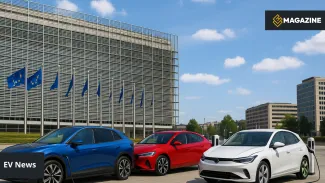
What actually changes on 1 January 2027
The TCA lets cars move between the EU and the UK duty-free — but only if they qualify as originating. For battery-electric passenger cars the product-specific rule has two layers: a regional value content threshold of 45% at vehicle level, and a separate, stricter origin requirement for the battery pack itself.
That second layer has been suspended since 2021. The EU-UK Partnership Council postponed it once already, to 31 December 2026. From 1 January 2027 the full rule applies: an electric car built in Germany, Czechia, Spain or Slovakia and sold in Britain must contain enough EU or UK value — including in the pack — or it is treated as a third-country import. That means 10% duty at the UK border on top of everything else.
ACEA's argument is short: Europe's battery supply chain is being built, but it is not built yet. And a rule of origin is not a target you can miss by a little. You either qualify or you pay.
Why the industry says the maths doesn't work
The problem is cells, not modules. Europe has plenty of assembly capacity and not nearly enough cell capacity, and the gap is measured in gigawatt-hours. Northvolt's collapse removed one of the largest planned European cell sources. The replacements — CATL's plant in Debrecen, the Spanish gigafactories, the German expansions — are ramping, but a cell plant takes three to four years from groundbreaking to stable output, and automotive qualification takes longer still.
European battery engineering itself is not standing still. We covered the LMFP truck pack developed by BMZ Poland with EVE — 10% lighter than LFP, 1 MW charging, 4,500 cycles. Impressive numbers. Commercial-vehicle volumes, however, are not what hundreds of thousands of passenger EVs per year require.
Our calculation: what a 10% duty costs per car
Tariffs get debated in percentages, which hides the money. Take an EU-built EV with a customs value of €35,000 — roughly a mid-spec compact crossover. A 10% duty adds €3,500 at the UK border. UK VAT at 20% is charged on the duty-inclusive value, so the retail effect is closer to €4,200 per car, before dealer margin, PDI or finance cost is layered on.
Set that against running costs. At €0.40/kWh and 18 kWh/100 km, a driver pays about €7.20 per 100 km. So €3,500 of duty equals roughly 48,600 km of charging — about four years of average UK annual mileage. Plug your own tariff and consumption into our charging cost calculator and the number moves, but not by a factor that makes the duty disappear.
Competitively, the position is worse than it looks. Britain has so far kept its standard 10% tariff on cars imported from outside the EU/UK, including Chinese-built EVs, and did not follow the EU's countervailing duties. An EU-built car that loses its duty-free status lands at the same border cost as a Chinese import — while UK-built cars such as the Nissan Leaf in Sunderland or the Mini in Oxford keep their position.
The UK side of the equation
Britain is not a passive party here. Its ZEV mandate requires 33% of new car sales to be zero-emission in 2026, 38% in 2027, 52% in 2028 and 80% by 2030. Roughly four out of five cars sold in Britain are imported, and most of those come from the EU. A price shock on EU-built EVs is a price shock on the mandate.
That is why the charging side keeps attracting money. EZO raised €150 million for 3,000 charge points across the UK and Ireland — roughly €50,000 per point — and England is dropping planning permission for cross-pavement charging from autumn 2026. Infrastructure is moving faster than the cell supply chain.
A difficult piece of timing
The EU is simultaneously negotiating to open new markets while risking the one it already has. Under the India-EU free trade agreement, EV tariffs fall to zero only by 2035, and the quota of 315,000 vehicles is not reached until 2040. Compare that with the UK, which already buys well over a million EU-built cars a year, and the asymmetry is obvious.
What happens next
Rules of origin live in an annex to the TCA, and the Partnership Council can amend them without reopening the treaty — precisely what ACEA is asking for, on a temporary basis. Whether the Commission and member states agree is another question. Those rules exist to force investment into European cell production, and relaxing them again removes some of the pressure.
For a UK buyer, the practical questions are delivery date and who absorbs the duty — a car ordered in 2026 and registered before the change sits on a different price list than one arriving in February 2027. For an EU buyer, the risk runs the other way: if UK demand softens, some of those cars stay in Europe. Either way, this is a policy risk that shows up on a price list, not in a WLTP figure.
Source: https://www.acea.auto/news/acea-proposal-on-eu-electric-vehicle-exports-to-the-united-kingdom/