
What Forum Mobility is actually building
Forum Mobility has grown quickly from a niche lessor into one of the more visible heavy-duty charging operators in the United States. It already runs Harbor, its depot at the Port of Long Beach, live since December 2024: 44 CCS connections with a combined 9 MW of power, now joined by two Tesla MCS Megachargers.
The new announcement adds four depots split between Northern and Southern California, partly MCS and partly CCS, each with drive-through lanes sized for trucks and trailers. Forum says the additions mean 30 MW of new capacity and take its total CCS + MCS capacity to 40 MW. The flagship is a site in Rancho Dominguez with 14 MW of chargers, due in Q1 2027 — and Forum claims commitments from 25 customers covering more than 330 Tesla Semi trucks for that location alone.
Public money is part of the mix. The Bay Area Air Quality Management District, the California Energy Commission and the California Transportation Commission all back the build.
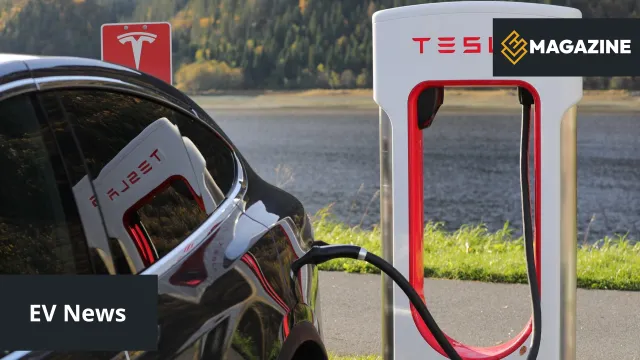
Tesla's Megachargers go public
The detail that matters most: Tesla will operate its own public Megachargers at three of the four new depots — Ontario, Adeline and Oakland. Until now, Megachargers have been captive infrastructure, installed for fleets such as PepsiCo. Making them public turns them into a commercial product, and that is where pricing walks in the door.
We have a decent benchmark for what US public fast charging costs. When Red E Charge switched on Plug & Charge at 579 sites, its tariffs spanned $0.40 to $1.15 per kWh. Apply that band to a class 8 truck and the spread is brutal. At 1.8 kWh per mile, $0.40/kWh means $0.72 per mile; $1.15/kWh means $2.07 per mile. Diesel at $4 a gallon and 6.5 mpg works out at roughly $0.62 per mile. A truck charged at the top of that band would not save a cent — it would lose money on every mile driven.
Cheap depot charging, in other words, is not a nice-to-have. It is the whole business case. No public tariff has been announced for those three Megacharger sites yet.
40 MW is a different order of magnitude
Passenger-car thinking does not survive contact with class 8 trucks. A loaded Semi runs at roughly 1.8 kWh per mile — about 112 kWh per 100 km, six to seven times what a family EV needs on the same road, where a compact electric typically sits at 16–18 kWh/100 km. Multiply by 100,000 miles a year and one truck burns 180,000 kWh annually, roughly the electricity of 45 average European households.
Hence the megawatt counting. Today's MCS hardware tops out near 1.2 MW, so 40 MW is theoretically about 40 trucks charging flat out at once. With taper and real duty cycles, a site that size is doing well to cycle two or three dozen packs an hour — each pack around 900 kWh, good for roughly 500 miles.
It also explains why depot economics hinge on the tariff rather than the charger count. A 14 MW site peaking even once a month can face a demand charge in the six figures, which is why the bigger truck depots increasingly pair chargers with on-site batteries to shave peaks. Charger efficiency matters too, but less than the brochures imply: we ran the numbers on Onsemi's EPP inverters, where 15% lower losses came to €2.90 a year for a passenger car. Scale that to a truck's 180,000 kWh and the same 15% cut in inverter losses saves maybe $200 a year — real, but small change next to the fuel bill.
The cost per mile, on paper
Assume 100,000 miles a year, 1.8 kWh/mile, and diesel at $4.00 a gallon with 6.5 mpg consumption:
- Diesel: ~15,400 gallons → ~$61,500/year (~$0.62/mile)
- Electric at $0.20/kWh: 180,000 kWh → $36,000/year ($0.36/mile)
- Electric at $0.25/kWh: $45,000/year ($0.45/mile)
- Electric at $0.40/kWh: $72,000/year ($0.72/mile) — already dearer than diesel
So the annual swing per truck runs from roughly $16,500 saved to $10,500 lost, before maintenance (no oil, no DEF, regen braking saving pads) and before the lease on the truck itself. Forum's CEO calls the total cost of ownership "highly favorable" — which is true at depot rates and not obviously true at public Megacharger rates. Watch the price list.
Where Europe stands
Europe is attacking the same problem from the regulatory side. AFIR, in force since April 2024, requires publicly accessible heavy-duty charging pools with at least one 350 kW point every 60 km on the TEN-T core network by the end of 2027, rising to 3,500 kW of total power per pool by the end of 2030. The Daimler–Traton–Volvo joint venture Milence is the main commercial answer so far, with hubs still measured in single-digit megawatts.
For scale: our own supercharger database tracks 483 locations across Europe, all of them passenger-car sites. Tesla's public Megacharger rollout is starting in California, not in Rotterdam or Leipzig. If you run a van or a light commercial vehicle today, our charging cost calculator is the fastest way to see what a given €/kWh does to your cost per 100 km.
What to watch
Two numbers decide whether this is a template or a subsidy story: the per-kWh tariff at Tesla's public Megachargers in Ontario, Adeline and Oakland, and how fast Tesla can build Semis to fill those 330 committed slots at Rancho Dominguez. Get the first number wrong and the second one will not matter much.
Source: https://www.electrive.com/2026/09/19/forum-mobility-expands-california-truck-charging-network/