
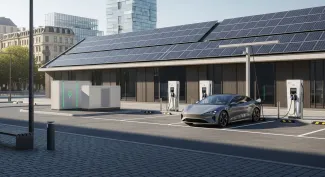
What is Huawei FusionCharge?
Huawei's FusionCharge Solution is not just another charger. It is an integrated energy ecosystem that combines photovoltaic (PV) systems, battery energy storage (ESS), and charging infrastructure with smart power distribution. The company provides hardware across the entire energy chain — from generation and storage to consumption — and partners with specialist providers for energy management systems (EMS), charge point management systems (CPMS), and payment solutions.
"We learned that the key is being completely open, completely cooperative, and able to integrate any kind of CPMS or EMS. Really any kind of third-party hardware," explains Alexander Wieler, Principal EV Charging Business Development Director at Huawei Digital Power.
This openness is crucial. Unlike closed ecosystems that lock operators into a single vendor, Huawei's platform supports integration of third-party chargers, batteries, and software. For European fleet operators who may already have existing infrastructure contracts, this interoperability reduces switching costs and future-proofs the investment.
Focus on depot and fleet charging
Huawei sees fleet and depot charging as the primary application. Depot operators can combine rooftop solar generation, battery storage, and managed charging to optimise energy use and reduce pressure on grid connections. "That's something we are very, very strong at," says Wieler.
The system can dynamically allocate charging power according to operational requirements. Vehicles requiring rapid turnaround — such as delivery vans on tight schedules — can receive higher charging power, while trucks or vans parked overnight can charge more slowly. A basic energy management function is included with the solution; more advanced requirements like load forecasting, solar generation prediction, or building energy management can be handled through third-party EMS providers.
"The market is ready," says Wieler. "Everything is becoming so much more connected and so much more complex."
Battery storage as the key enabler
The newest addition to the FusionCharge ecosystem is a DC-coupled battery energy storage system. This architecture allows solar energy to be stored directly in batteries and later supplied to charging stations, while also drawing additional power from the grid when required. According to Huawei, the system is particularly suitable for charging hubs where grid capacity is limited or grid upgrades would be costly.
A single charging cluster can connect up to 12 connectors, with power distributed dynamically according to demand. "You can really contribute the power exactly where you need it, when you need it," Wieler adds.
For European operators, this is a critical feature. Grid connection upgrades in many EU countries can take 12–24 months and cost tens of thousands of euros. A battery buffer — even a modest one — can reduce peak demand charges and allow operators to install more charging capacity than the grid connection alone would support. Our supercharger database shows that charging prices vary significantly across Europe, and operators who can store cheap off-peak energy or self-generated solar power can offer more competitive rates.
European angle: why this matters now
Commercial vehicle electrification is accelerating across Europe. The EU's CO2 standards for heavy-duty vehicles require a 45% reduction in emissions by 2030 compared to 2019 levels, effectively mandating a rapid shift to electric trucks and buses. This creates enormous demand for depot charging infrastructure — and grid capacity is the bottleneck.
Huawei's integrated approach addresses this directly. Instead of waiting for grid upgrades, operators can deploy solar + storage + charging as a self-contained system. This is particularly relevant for logistics hubs in Central and Eastern Europe, where grid infrastructure is often older and less robust than in Western Europe.
We have covered the accelerating EV market in Europe extensively. In our analysis of EU electric car sales surging 61% in June, we noted that over 270,000 BEVs were registered as market share hit 21%. The commercial vehicle segment is following the same trajectory, and charging infrastructure must keep pace.
Similarly, our report on one in four new cars sold in Europe now being electric in H1 2026 shows that the transition is accelerating across all vehicle classes. Fleet operators who delay infrastructure investments risk being caught short.
Competition and context
Huawei is not alone in this space. ABB E-mobility offers its HVC series with integrated energy storage, and ChargePoint has its Express Plus platform with power sharing. Tesla is deploying Megapack-based charging hubs for its Semi fleet. What sets Huawei apart is the breadth of the ecosystem — from solar panels to batteries to chargers to software — all from a single vendor with a strong track record in power electronics.
However, Huawei faces headwinds in some European markets due to security concerns around its telecommunications equipment. While its digital power division is a separate entity, the brand association may affect adoption in sensitive sectors like public transport or government fleets.
Practical takeaway for operators
If you are managing a fleet depot in Europe and considering electrification, here is what Huawei's announcement means in practical terms:
- Grid constraints are solvable — battery storage can reduce peak demand by 30–50%, depending on the duty cycle. Use our EV savings calculator to model the economics for your specific operation.
- Solar + storage + charging is a proven combination — the technology is mature, and the payback period in sunny regions (Southern Europe) can be as short as 4–6 years.
- Open platforms reduce risk — Huawei's commitment to third-party integration means you are not locked into a single vendor for software or hardware.
- Act now — as Wieler notes, "We need to act now to have the infrastructure needed to fully support the electrification of the bus and truck sector." Grid connection queues are already stretching into 2028 in some EU countries.
For a deeper dive into charging infrastructure costs across Europe, check our cheapest superchargers page, which tracks real-world pricing at 483 locations. And if you are considering a home or business solar + storage setup, our EV tariff calculator can help you compare time-of-use rates across European markets.
How does DC-coupled battery storage differ from AC-coupled systems?
In a DC-coupled system, solar panels charge the battery directly via a DC-DC converter, avoiding the efficiency losses of converting DC to AC and back. This typically yields 3–5% higher round-trip efficiency compared to AC-coupled systems, which is significant for high-utilisation depot charging.
Is Huawei's solution available in all EU countries?
Huawei Digital Power has a presence in most EU markets, but availability of the full FusionCharge ecosystem — including the DC-coupled battery — varies by country. Operators should contact local Huawei representatives for specific product availability and certification status (CE, IEC, etc.).
What is the typical payback period for a depot solar + storage + charging system?
This depends heavily on local electricity prices, solar irradiance, and utilisation rates. In Southern Europe with high electricity prices (€0.25–0.35/kWh), payback can be 4–6 years. In Northern Europe with lower prices and less sun, it may extend to 8–10 years. Battery storage alone typically adds 2–3 years to the payback period but can be justified by avoiding grid upgrade costs.