
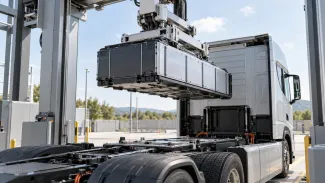
One deal, two swapping standards
Qiyuan Green Power, owned by China Power under State Power Investment Corporation, runs China’s largest heavy-truck battery swapping network. Its rear-mounted swapping system is known for compatibility: it fits over 80% of existing battery-swapping heavy trucks in China. That matters in closed and semi-closed fleets — mines, ports, steel mills, urban construction — where the truck returns to the same depot and a standardised rear pack can be exchanged quickly.
CATL’s own heavy-truck brand, Qiji, takes a different route. Its No. 75 chassis-based standard is designed for new, standardised trucks and aimed squarely at China’s national highway logistics corridors. The acquisition puts both technical paths under one roof, which is less about hardware and more about controlling the standard for the next generation of heavy-duty electric trucks.
The numbers behind the network
By the end of 2025, Qiyuan had more than 1,600 charging and swapping stations across 208 prefecture-level cities, with cumulative operational mileage above 4.4 billion km. CATL’s Qiji brand had around 300 stations at the same point, with a target of 900 stations in 2026 to form a “five horizontal and five vertical” backbone across major highway corridors.
For scale: our own supercharger database tracks 483 locations across Europe. Qiyuan alone operates more than triple that, and it is focused only on heavy trucks. The comparison is not exactly like-for-like — our database counts public CCS fast-charging sites, Qiyuan counts dedicated swap stations — but it shows the fundamental difference in infrastructure philosophy. China is building swapping as a large-scale industrial system; Europe is still wiring up fast chargers.
Why swapping works for heavy trucks
The logic is not complicated. A heavy truck battery is large, heavy and expensive, and downtime costs real money. Charging at multi-megawatt levels is thermally demanding; a swap can have a truck back on the road in minutes. CATL is also pushing passenger-vehicle swapping with 2,000 Choco-SEB stations already running as of H1 2026 and a target of 3,000 stations by 2026. Light-truck swapping is currently operating in the Pearl River Delta.
Heavy-duty electrification is a different problem than passenger cars. We have covered one European answer before: the Tesla Semi’s European launch at IAA bets on 800 km of range and 1.2 MW charging, not swappable packs. CATL’s Qiji is taking the opposite path — shorter range, but almost zero charging wait. Which one wins depends on logistics, not marketing.
What happens next
The deal carries a 120% premium over Qiyuan’s book value, which is a strong signal of how much CATL wants the network. What is still open: the final integration timeline, the exact ownership structure after registration, and whether Qiyuan’s rear-mounted standard and Qiji’s chassis-based standard can actually share a single business without cannibalising each other.
This is also not happening in isolation. CATL is one of the Chinese cell makers targeting 2027 solid-state trial production, alongside BYD and Geely. We covered that in China’s Cell Makers Target 2027 Solid-State Trial Production. The battery maker is scaling cells and the infrastructure to swap them at the same time.
For now, the news is a China story. The next data point will be whether CATL can hit its 900 Qiji station target in 2026 while absorbing Qiyuan’s existing 1,600-plus network — and whether that scale changes what heavy-truck operators outside China consider normal.