
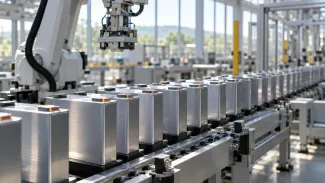
According to China EV DataTracker data cited by CarNewsChina, CATL held 42.9% of the Chinese battery market in July 2026. BYD ranked second with 19.5%. CALB, Gotion High-Tech, and EVE Energy round out the top five. The top four together account for more than 75% of China’s battery output — and all four now have 2027 trial production plans.
The 2027 club keeps growing
BYD has published six solid-state battery patents and committed to 2027 trials using dual-electrolyte cathode cells. CATL has reiterated the same 2027 timeline to investors. Geely has gone further with a claimed 500 Wh/kg cell and wants pilot deployment and real-world validation in 2027, promising “diesel-like” range for EVs.
This is not happening in a vacuum. China’s State Council set the direction back in 2020 with the New Energy Vehicle Industry Development Plan (2021–2035), which explicitly targets accelerating solid-state battery development. The 2027 deadline is now the industry’s common answer.
Who else is in the chasing pack?
CALB, China’s third-largest battery maker, plans small-scale EV validation in 2027 and full production in 2030–2032. That timeline is important because CALB is still rebuilding its reputation after the swelling “banana cells” reported in GAC Aion EVs. Cell chemistry claims mean little if production quality is not there.
Gotion High-Tech, backed by Volkswagen, is prioritising 350 Wh/kg solid-state cells, with road tests in 2027 and commercial production in 2029–2030. Farasis Energy, backed by Mercedes-Benz, also aims for 2027 EV validation and full production in 2030. EVE Energy says it has developed sulfide-based cells in the Ah range and plans first-generation cells at 350 Wh/kg and 800 Wh/L in 2026, followed by second-generation 1000 Wh/L cells in 2028.
Then there is Dreame Technology, a company better known for robotic vacuums. It claims its “Galaxy Crystal” cells reach 60 Ah capacity and over 450 Wh/kg, with small-scale deliveries in 2026 and full production in 2027. I treat that claim with a large grain of salt. A vacuum maker promising full solid-state production in 2027 is exactly the kind of announcement that should be labelled prototype, not product.
What do the energy density numbers actually mean?
A 500 Wh/kg cell is not a 500 Wh/kg battery pack. Pack enclosures, cooling, and electronics typically eat 25–30% of the mass at pack level. At a realistic 70% pack efficiency, a 500 Wh/kg cell gives you about 350 Wh/kg at pack level.
Here is the math: an 80 kWh pack at 350 Wh/kg would weigh roughly 229 kg. Many current 80 kWh packs weigh around 400–500 kg. That is a nearly 50% weight saving — if the cell-level numbers survive real-world validation. The same logic applies to volumetric figures. EVE’s 800 Wh/L first-generation target is ambitious, and its 1000 Wh/L second-generation goal is even more so.
When these packs arrive, the real-world range question will matter more than the spec sheet. Our real-world range calculator exists for exactly that reason — WLTP numbers do not tell you how a car behaves in winter or at highway speeds.
What should a buyer do today?
Do not delay an EV purchase waiting for a solid-state car. The first trial cells in 2027 will not be in showroom vehicles. Commercial production targets run 2029–2032, and early solid-state packs will almost certainly be expensive and limited to top models.
Our EV catalog currently lists 67 production models with full specifications, and exactly none of them use solid-state cells. That is the clearest sign of how early this technology is. Battery costs and tariffs are already reshaping what you pay for an EV — as we covered in our look at the 2027 Lucid Air’s $70,900 entry price. Solid-state cells are unlikely to make EVs cheaper in the short term.
The 2027 race is worth watching, but it is a race toward validation, not mass production. I will judge any solid-state car by real-world range, charging curves, cost per kWh, and degradation — not by a press release.