
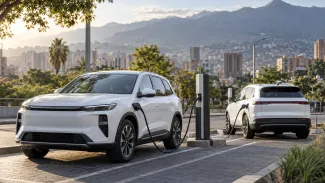
Leapmotor brings two EREVs, not pure battery EVs
Leapmotor’s Argentine launch starts with two five-seat crossovers fitted with a combustion engine used as a generator. The wheels are driven by an electric motor, while petrol extends the journey once the battery is depleted. In China this architecture is commonly called EREV, or extended-range electric vehicle.
The smaller Leapmotor B10 costs $31,990. It measures 4,530 mm long, has a 2,735 mm wheelbase and a 350-litre boot. Its 18.8 kWh LFP battery supplies a claimed 95 km electric range, while the 158 kW electric motor provides 212 hp. DC charging peaks at 46 kW.
At face value, the charging figure sounds modest. But the battery is also modest: dividing 18.8 kWh by 46 kW gives a theoretical 24.5-minute full charge before charging losses and the inevitable taper near 100%. In normal use, charging from 10% to 80% should therefore be a relatively short stop—provided a 50 kW DC charger is available and functioning.
The larger Leapmotor C10 starts at $35,500, just $3,510—or around 11%—above the B10. It stretches to 4,739 mm, has a 2,825 mm wheelbase and a more useful 435-litre boot. Its 28.4 kWh LFP pack has a quoted 170 km NEDC electric range, and it accepts up to 65 kW DC charging. The same simple battery-versus-power calculation produces a theoretical 26-minute full charge at peak power.
That is a useful reminder that headline kW alone does not determine whether a car charges quickly. Battery capacity, charging curve and usable charging window matter more. Owners comparing EV specifications can keep those values in one place through our EV catalogue, while our charging cost calculator is useful for translating local electricity prices into a cost per 100 km.
BYD’s reported 89% share leaves very little room
According to Car News China’s report, Argentina registered around 10,800 electrified cars in the first six months of 2026, including 5,600 plug-in hybrids and 4,200 battery-electric vehicles. If BYD’s reported 89% market share applies to that full 10,800-unit segment, the Chinese manufacturer accounted for approximately 9,612 vehicles.
That leaves only about 1,188 registrations for every other brand combined. For a new entrant, this is not merely a fight against one successful model; it is a fight against an established sales machine with dealer presence, model breadth and pricing already set for the market.
The reported segment data also deserves careful reading. The stated 5,600 plug-in hybrids plus 4,200 BEVs equal 9,800 cars, leaving roughly 1,000 of the 10,800 total in another electrified category or in a reporting classification not detailed in the source. This is exactly why market-share headlines need a definition attached: “EV” can mean BEV only, all plug-ins, or a broader hybrid-inclusive category depending on the local dataset.
Price positioning is close, but BYD has the broader lineup
Leapmotor is entering directly into BYD territory. The BYD Yuan Up DM-i plug-in hybrid reportedly starts at $33,990 in Argentina, putting the B10 $2,000 below it. The larger BYD Song Pro DM-i, also sold as the Sealion 6 in some markets, is priced from $35,490 to $37,490. That places the C10 virtually level with the entry Song Pro DM-i: only $10 more.
Those are sensible price points, but a similar sticker price does not make the products identical. Leapmotor’s C10 offers a 28.4 kWh battery and 170 km NEDC electric claim; the B10’s 95 km claim is more relevant for daily commuting but still uses an optimistic laboratory cycle. NEDC figures should not be treated as a guaranteed real-world result, especially with air conditioning, motorway driving or a full family on board.
BYD, meanwhile, already offers several body styles in Argentina, from the Dolphin Mini and Yuan Pro to the Shark pickup and Seal U DM-i. A buyer who wants one dealer, one financing channel and several vehicle formats has an obvious reason to start there. Leapmotor’s immediate advantage is not product variety but Stellantis infrastructure.
Stellantis gives Leapmotor a practical route into the country
Leapmotor says it begins with 12 sales outlets and 20 dedicated after-sales points, while basic servicing can be handled through more than 300 Stellantis after-sales locations. For an unfamiliar Chinese badge, that is arguably more important than an extra screen mode or a marginal power advantage.
A range-extender SUV still has an engine, oil and conventional mechanical components. Accessible servicing therefore matters more than it would for a straightforward BEV. The Stellantis connection also distinguishes Leapmotor’s strategy from a pure import-and-distribute approach.
Chinese manufacturers are increasingly using local partnerships rather than treating South American markets as simple export destinations. We recently covered how GM paired dealership charging with Chevrolet EV sales in Peru; the common lesson is that charging, service and ownership support can matter as much as the launch price.
What happens next
Leapmotor has chosen a realistic opening position: two crossovers, prices close to BYD’s competing plug-in SUVs and a service network that buyers already recognise. But Argentina’s current plug-in market is still small in absolute terms—about 1,800 vehicles per month based on the reported first-half total—and BYD’s reported dominance leaves little space for errors.
The first question is whether Leapmotor can convert Stellantis’ service footprint into actual consumer confidence. The second is whether it expands beyond two EREVs quickly enough to offer buyers a genuine choice against BYD’s growing catalogue. For now, the B10 and C10 are not a disruption of Argentina’s EV market. They are a well-supported first attempt to take some of BYD’s very large slice of a still developing pie.