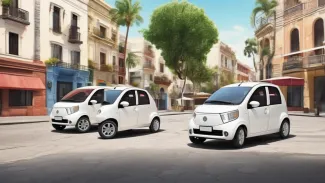
For decades, Mexico has been one of the world's top vehicle assembly hubs, churning out cars for Ford, GM, VW, and Stellantis. But assembling other nations' designs is very different from creating your own. The Olinia Uno, designed, developed, and manufactured entirely in Mexico, represents a deliberate departure from that tradition — a bet that Latin America can build not just bodies and chassis, but the technology within them.
Six Seats, 125 Kilometres, $8,600
The Uno is, by any Western standard, a modest vehicle. Its 18-horsepower electric motor tops out at 50 km/h (31 mph), firmly placing it in the neighbourhood electric vehicle (NEV) category. The 14.7 kWh lithium iron phosphate battery offers a range of 125 kilometres (77 miles) on a charge — enough for daily urban routes, taxi runs, and short commutes across dense city grids. Charging takes four hours from a standard 220V household outlet. There is no fast charging.
What sets the Uno apart is its passenger capacity. Six seats in a vehicle this size and price point is an unusual engineering choice — one that targets Mexico's booming micro-taxi and shared mobility market, where squeezing in as many passengers as possible per trip is an economic priority. The car also includes wheelchair accessibility, LED headlights, power windows and locks, a reverse camera, and a Bluetooth radio. These aren't luxury features; they're the practical tools of a working vehicle.
The trade-offs are equally clear: no airbags, no air conditioning. In a country where summer temperatures regularly exceed 35°C, the absence of A/C will limit the Uno's appeal outside urban corridors and cooler highland cities. The lack of airbags is a more significant concern for safety advocates, though the 50 km/h top speed considerably lowers the risk profile in city driving.
State Backing and 2,000 Charging Stations
Olinia isn't operating alone. The Mexican government has announced plans to roll out 2,000 charging stations across the country to support EV adoption — infrastructure that would benefit not just the Uno, but any future domestic or imported electric vehicles. State involvement in the project is part of a broader ambition to position Mexico as an EV manufacturing nation, not merely an assembly one.
The timing is deliberate. With the global auto industry under pressure from Chinese competitors offering increasingly affordable EVs, Mexico is attempting to carve out its own niche. Rather than compete head-on with BYD or SAIC in the premium or mid-range segments, Olinia is targeting a price point and use case those manufacturers haven't prioritised: the hyper-local, hyper-affordable urban mobility segment in developing markets.
A Mirror for Emerging Markets Globally
The Uno is not unique in concept — India's Tata Motors has long sold small urban EVs, and China's domestic market is flooded with sub-$10,000 NEVs like the Wuling Hongguang Mini EV. What's different here is the nationally manufactured angle. Mexico is staking a claim to indigenous EV production at a moment when the global supply chain is fragmenting, tariffs are rising, and nations are being forced to decide: do you want to build it, or buy it?
For European readers, the Uno offers a useful lens on how EV adoption looks in markets where purchasing power is fundamentally different. Europe's cheapest EVs — the Dacia Spring, the Citroën ë-C3 — start around €16,000–€18,000. At $8,600, the Olinia Uno costs roughly half that. It achieves this by accepting constraints that European safety and homologation rules would never permit, but in the context of Mexican urban mobility, those constraints matter far less than accessibility and affordability.
The Road to Summer 2027
Production of the Uno is scheduled for summer 2027, giving Olinia just over a year to finalise manufacturing at scale, build supply chain relationships for its LFP battery cells, and validate quality control processes. That timeline is tight for a startup, even a state-backed one. The history of well-intentioned national EV projects — from Malaysia's Proton attempts to various African electrification schemes — shows that bridging the gap between prototype and reliable mass production is often where ambitions collide with reality.
Olinia will need to demonstrate not just that the Uno can be built, but that it can be serviced, insured, and operated at the claimed price point under real-world conditions. If it succeeds, it could become a template for affordable urban EVs across Latin America and beyond. If it struggles, it will join a long list of promising national EV projects that underestimated the complexity of the journey from press release to production.
Either way, the Uno is a statement of intent. Mexico has a long history of building the world's cars. Now it wants to build its own.
Is the Olinia Uno legal to drive on regular roads in Mexico?
The Uno is classified as a neighbourhood electric vehicle (NEV) with a top speed of 50 km/h, which limits it to urban streets and zones with speed limits at or below that threshold. It is not designed or approved for motorway or highway use. Mexican regulations allow this category of vehicle for city driving and commercial micro-taxi operations.
Why does the Olinia Uno have no airbags?
The Uno targets the ultra-affordable urban mobility segment, where price point and passenger capacity take priority over features that add cost. Its 50 km/h speed cap also significantly reduces collision severity compared to highway-capable vehicles. That said, the absence of airbags means the Uno would not meet the safety homologation requirements needed to sell in the European Union or the United States.
Could a vehicle like the Olinia Uno ever be sold in Europe?
Not in its current form. EU type-approval regulations require airbags, pedestrian safety systems, and minimum crash-test standards that the Uno does not meet. However, a re-engineered version meeting EU standards would likely cost significantly more than $8,600, reducing its key competitive advantage. The Uno is purpose-built for emerging markets with different regulatory frameworks.
Source: https://insideevs.com/news/798256/mexico-olinia-uno-ev-cheap/