
Listen to this article:
A Partnership Two Generations in the Making
The relationship between Stellantis — then PSA Group — and Dongfeng Motor stretches back to 1992, making it one of the longest-running Sino-foreign automotive partnerships in existence. That history gave birth to DPCA (Dongfeng Peugeot Citroën Automobile Co., Ltd), the joint venture that has produced Peugeot and Citroën vehicles for the Chinese market for decades. But in recent years, DPCA faced the same headwinds that have battered other legacy joint ventures in China: sinking market share as domestic brands like BYD and Geely surged ahead in the electric transition.
Rather than retreat, Stellantis is doubling down. The agreement signed this week between Stellantis CEO Antonio Filosa and Dongfeng Group Chairman Qing YANG transforms DPCA's Wuhan plant from a China-only operation into a global manufacturing hub. The total investment: over 8 billion Chinese yuan, or roughly €1 billion, with Stellantis contributing approximately €130 million — a relatively modest sum for a project of this ambition, thanks to favourable industrial policies from the Hubei provincial government and Wuhan municipality.
Four New Vehicles, Two Iconic Brands
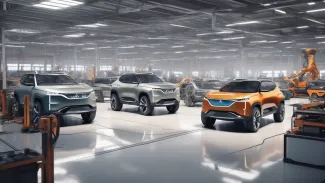
Under the deal, DPCA's Wuhan facility will initially produce four all-new new energy vehicles from 2027. Two will wear the Peugeot lion badge, built on the latest design language previewed by the Peugeot Concept 6 and Peugeot Concept 8, both unveiled at the 2026 Beijing International Auto Show in late April.
The Concept 6 presents a bold vision for a new generation of large sedans — a feline silhouette merging sedan elegance with shooting-brake dynamism. The Concept 8, meanwhile, points toward Peugeot's future large SUV ambitions, with a pure, aerodynamic design that emphasises efficiency and presence. Both concepts are unmistakably Peugeot: emotionally expressive, characterised by the brand's signature "feline" design language, and, beneath the skin, they will benefit from Dongfeng's deep expertise in intelligent electric vehicle technology.
These Peugeot models are intended for the Chinese market and for export, forming a core pillar of Peugeot's international growth strategy. The significance cannot be overstated: Chinese-built Peugeot EVs will compete on dealer forecourts in markets far beyond Asia.
The agreement also covers production of two Jeep-branded off-road new energy vehicles for global markets, also from 2027. Jeep's off-road DNA — genuine capability, not just styling — will now meet Dongfeng's electric powertrain technology in what could become one of the more intriguing EV propositions of the late 2020s.
What This Means for Stellantis in China — and for Europe
The Wuhan deal is not happening in isolation. It is part of a broader web of Stellantis-China alliances that has been quietly woven over the past three years. In October 2023, Stellantis invested €1.5 billion for a roughly 20% stake in Leapmotor, the fast-growing Chinese EV maker that delivered a record 71,387 vehicles in April 2026 alone. The Leapmotor partnership has already yielded concrete results — including a new Opel-badged electric SUV being co-developed with Chinese technology, reportedly targeting 2028 production. Stellantis has also been in discussions with FAW's Hongqi brand about potentially utilising its Spanish plant in Zaragoza for European production.
For European readers, the deal cuts two ways. On one hand, it demonstrates that a major European automaker still sees a future in China — not as a junior partner, but as an operator capable of building world-class EVs on Chinese soil for global distribution. On the other, it means Peugeot and Jeep EVs bearing "Made in China" plates could soon appear in European showrooms, adding another layer to an already complex conversation about where Europe's cars come from.
The non-binding strategic MoU signed alongside the production agreement hints at even deeper cooperation to come, with both parties pledging to leverage their combined scale, R&D capabilities, and industrial expertise.
A Pragmatic Bet in a Shifting Landscape
China's NEV market penetration hit a historic 61.4% in April 2026, with internal combustion vehicle sales collapsing at a pace few predicted. For any global automaker, a credible China strategy now requires a credible EV strategy — and Stellantis' approach of combining its iconic European brands with Dongfeng's homegrown EV technology is, at the very least, more concrete than hoping a combustion-era badge alone will carry the day.
The deal remains subject to final implementation agreements, economic and operational conditions, and customary regulatory approvals. But if the timeline holds, the first fruits of this renewed 34-year alliance will begin rolling off Wuhan assembly lines within 18 months. By then, the global EV landscape will have shifted again — and Stellantis is betting this partnership keeps it on the right side of that shift.
What is DPCA and why does this deal matter?
DPCA (Dongfeng Peugeot Citroën Automobile Co., Ltd) is the long-standing joint venture between Stellantis and Dongfeng Motor Group, founded in 1992. The deal transforms it from a China-focused manufacturer into a global export hub for Peugeot and Jeep electric vehicles, backed by over €1 billion in investment.
When will the new Peugeot and Jeep EVs be available?
Production is expected to begin in 2027 at the DPCA plant in Wuhan, China. The timeline depends on finalisation of implementation agreements and regulatory approvals. The Peugeot models will target both the Chinese domestic market and export markets, while the Jeep off-road NEVs are aimed primarily at global export.
Are these vehicles related to the Leapmotor-Stellantis partnership?
Not directly. The Leapmotor-Stellantis partnership is a separate alliance (Stellantis owns roughly 20% of Leapmotor) focused on co-developing affordable EVs, including a planned Opel model. The Dongfeng deal is an independent strategic agreement, though both reflect Stellantis' broader strategy of deepening ties with Chinese automotive and technology companies.