
Listen to this article:
Wade Mode Was Never Submarine Mode
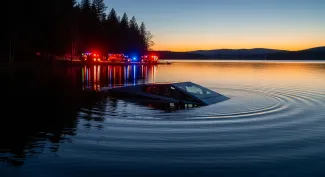
On Monday evening, May 19, 2026, officers from the Grapevine Police Department in Texas responded to Katie's Woods Park Boat Ramp after a Tesla Cybertruck became stranded in the water. According to the department, the driver intentionally entered the lake to activate the Cybertruck's Wade Mode feature — apparently convinced that this was the moment to test Musk's famous water-crossing claim.
The truck became disabled and began taking on water. Passengers were forced to abandon the vehicle and wade to shore. The Grapevine Fire Department's Water Rescue Team was dispatched to extract the Cybertruck from the lake. By then, the damage — both to the truck and to the driver's legal situation — was already done.
The driver was arrested at the scene and charged with:
- Operating a vehicle in a closed section of park/lake
- Lacking valid boat registration
- Multiple water safety equipment violations
As of the time of writing, the driver remains in custody.
What Elon Musk Actually Said
To understand why anyone would drive a truck into a lake, it helps to revisit what Tesla's CEO promised. Back in 2022, Elon Musk posted on X (then Twitter) that the Cybertruck would be "waterproof enough to serve briefly as a boat." He specifically referenced crossing the roughly 360-metre stretch of water between SpaceX's Starbase facility and South Padre Island in Texas. The post went viral — and, evidently, some buyers took it at face value.
The reality of Wade Mode is far more modest. The feature pressurises the Cybertruck's battery pack and raises the ride height to support water crossings of a maximum depth of approximately 32 inches (about 81 centimetres) — roughly the depth of a shallow creek or flooded road. It was never designed for open-water navigation. It is, in effect, a deep-puddle feature, not a lake-crossing capability.
California Highway Patrol put it bluntly after a similar incident in 2025: "Wade Mode isn't Submarine Mode."
A Growing Pattern of Dangerous Misunderstanding
The Texas incident is not an isolated case. Over the past year, a troubling pattern has emerged:
- In 2025, a California Cybertruck owner got his vehicle stuck after activating Wade Mode in deeper water.
- Also in 2025, a Cybertruck sank in Ventura Harbor while its owner attempted to launch a jet ski — the truck slid too far down the boat ramp and submerged.
- A separate incident occurred in Slovakia, where another Cybertruck became trapped attempting a water crossing in a lake.
Each of these cases shares the same root cause: a mismatch between what was promised at launch and what the vehicle can actually do. When a CEO publicly compares a road vehicle to a boat, some customers will eventually test that claim — regardless of what the owner's manual says.
Tesla's Liability and the Broader Issue of EV Hype
The Cybertruck's marketing journey has been remarkable for its distance from conventional automotive practice. Most manufacturers are legally cautious in the extreme about capability claims. Tesla under Musk has historically operated differently — announcing features, ranges, and capabilities that sometimes arrive years late, in diminished form, or not at all.
The water-crossing claim is a particularly vivid example. Tesla never published specifications suggesting the Cybertruck could function as a boat, and the vehicle's official documentation is clear about Wade Mode's limitations. But the gap between Musk's public statements and the fine print in the manual has repeatedly proved dangerous.
European regulators and consumer protection bodies have been watching Tesla's communications practices with increasing scrutiny. The EU's General Product Safety Regulation, strengthened in 2024, places greater obligations on manufacturers to ensure that marketing communications — including social media posts by senior executives — do not mislead consumers about safety-critical capabilities.
What the Cybertruck Can — and Cannot — Do in Water
For Cybertruck owners who want to understand the actual limits of their vehicle:
- Wade Mode depth: Maximum approximately 32 inches (81 cm)
- What it does: Pressurises the battery pack, raises ride height, seals the cabin more tightly
- What it does not do: Make the vehicle buoyant, watertight at depth, or navigable on open water
- Speed limit in Wade Mode: Tesla recommends no more than 5 mph (8 km/h) through water
- Duration limit: Tesla recommends no more than 30 minutes of water exposure
None of these specifications resemble a boat. The Cybertruck is, by any reasonable measure, a road vehicle — one that can handle a flooded street better than most, but not a lake crossing by any stretch of the engineering.
The Human Cost of Hype
What makes incidents like the one in Grapevine Lake genuinely concerning is not just the legal and financial damage to the individual owners. It is the risk to life. The passengers who abandoned the vehicle in Grapevine Lake were fortunate. A sinking vehicle in deep water, at night, presents a serious drowning risk. Emergency responders were required to mobilise, at public expense, to deal with the consequences of a misunderstanding that may never have arisen had the original claim been made more carefully.
There is a wider lesson here for the EV industry. As electric vehicles become more capable — and as features like wade modes, autonomous driving, and long-range performance become selling points — the responsibility on manufacturers and their leaders to communicate accurately becomes greater, not smaller. The Texas arrest is, among other things, a reminder of what happens when marketing outruns the specifications sheet.
What exactly is Tesla's Wade Mode and how deep can the Cybertruck go in water?
Wade Mode pressurises the Cybertruck's battery pack and raises its ride height to allow crossing of water up to approximately 32 inches (81 cm) deep — roughly the depth of a flooded road or shallow creek. It is not designed for lake or river crossings. Tesla recommends a maximum speed of 5 mph and no more than 30 minutes of water exposure when using Wade Mode.
Can Tesla be held legally responsible when owners take Elon Musk's capability claims literally?
This is a complex legal question. Tesla's official documentation accurately describes Wade Mode's limitations, which provides significant legal protection to the company. However, regulators in the EU and elsewhere are increasingly scrutinising whether executive social media posts can constitute misleading marketing, particularly for safety-critical vehicle features. No liability case against Tesla related to the Wade Mode incidents has succeeded in court as of 2026.
Has this type of incident happened in Europe as well?
Yes. At least one incident of a Cybertruck becoming stuck in a Slovak lake has been reported, following the same pattern as the US cases. With Cybertruck availability gradually expanding, European regulators and consumer organisations have been watching these cases closely.
Source: https://electrek.co/2026/05/19/tesla-cybertruck-owner-believed-elon-musk-lake-jail/