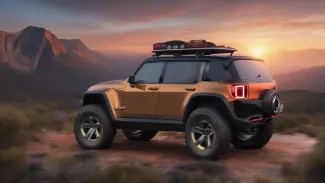
When Stellantis unveiled the Recon EV and Wagoneer S to global fanfare a few years ago, both were held up as proof that Jeep could ride the electric wave without losing its rugged soul. The Recon, in particular, was marketed as a spiritual successor to the Wrangler — a proper off-roader reimagined for zero-emission trails. European customers had been waiting.
They will wait no longer. Jeep has officially pulled the plug on both models for Europe and the UK, citing a combination of unfavorable market conditions, the prohibitive cost of right-hand drive engineering, and sales projections that simply could not justify the investment. A company spokesperson confirmed the decision: "Tough market conditions and the cost of right-hand drive development would have made these cars untenable, especially considering the small sales projections."
Why the Recon and Wagoneer S Are Gone
The cancellation is painful, but not entirely surprising. Stellantis has been navigating a difficult financial period, with the group issuing a series of profit warnings and restructuring announcements through 2025 and into 2026. European EV demand has remained uneven — growing overall, but still concentrated in Scandinavia and a handful of urban markets. For a brand like Jeep, whose buyers tend to be drawn to weekend adventure rather than urban commuting, the business case for two expensive, purpose-built electric SUVs was always fragile.
The Wagoneer S — a three-row, premium electric SUV aimed squarely at the Range Rover Sport and Audi Q8 e-tron — also ran into the same problem facing many large American EVs in Europe: they are simply too big, too expensive to locally adapt, and competing in a segment where established European names have deep loyalty.
Right-hand drive development costs — required for the UK market specifically — reportedly tipped the balance. Without the UK, the volumes for a premium niche EV in the remaining European markets became very difficult to justify on a standalone basis.
Three New SUVs to Fill the Gap
Jeep's European boss Fabio Catone has made it clear this is not a retreat — it is a repositioning. Three new models are being developed specifically for the European market, and each reflects a very different approach than the scrapped EVs.
A Chinese-Built D-Segment Flagship
The most significant newcomer will be a large D-segment SUV manufactured in China through Jeep's long-standing joint venture with Dongfeng. This is a departure from Jeep's traditional American manufacturing roots, but Catone frames it as a pragmatic step — comparing the model to an iPhone: fully designed by Jeep, carrying the brand's DNA and identity, but leveraging Chinese industrial infrastructure for cost and scale efficiency.
The flagship will be offered with three powertrain options: a conventional hybrid, a pure battery-electric variant, and a range-extended electric (REEV) setup — a configuration that is rapidly gaining popularity in China, where drivers prize longer practical range above all else. It is also a smart hedge: Jeep can sell the same platform to customers who are not ready for pure electric but want lower emissions than a traditional petrol engine delivers.
Two New Compact and Subcompact SUVs
The other two additions are B-segment and C-segment SUVs, both riding on Stellantis' new STLA One modular platform — the same architecture underpinning the next generation of Peugeot, Citroën and Opel models. This platform is designed from the outset for multi-powertrain flexibility: fully electric, plug-in hybrid, or mild hybrid.
One of the two models will be a compact SUV positioned below the current Compass but wider and more SUV-styled than the Avenger — addressing feedback that the Avenger, while successful in urban markets, lacks the visual presence and off-road credibility that Jeep's core buyers expect. The second will slot between the two, offering a C-segment option that fills a gap in Jeep's European lineup that has existed since the Compass was first introduced.
Both models will feature STLA Brain (Stellantis' next-generation connected vehicle software), SmartCockpit infotainment, and steer-by-wire — technologies that place them firmly in the modern premium segment rather than just the mass-market.
What This Means for European Jeep Buyers
In the short term, European customers lose two EVs that were genuinely exciting on paper. The Recon EV, in particular, had attracted a loyal audience of Wrangler fans who wanted to go electric without abandoning their off-road lifestyle. There is no direct replacement on the horizon for that specific niche.
But the three new models address a broader question: can Jeep grow its volume in Europe rather than remaining a specialist, low-volume brand? The Avenger has already proven there is appetite for an affordable Jeep EV in Europe — it became one of the brand's best sellers almost immediately after launch. The new B-segment and C-segment models follow that logic, targeting mainstream buyers rather than premium off-road enthusiasts.
The Chinese-built flagship is a bolder, more contentious move. Jeep is not the first Western brand to manufacture in China for global markets — Stellantis has been expanding its Dongfeng partnership for several years — but it will face scrutiny in an environment where European consumers and policymakers are increasingly attentive to supply chain origins. Tariff dynamics between the EU and China also remain in flux, which adds financial uncertainty to any China-sourced vehicle strategy.
Jeep in the Context of Stellantis' Bigger Bet
The Jeep reset sits within Stellantis' broader Fastlane 2030 plan, which commits the group to 29 new electric models across its brands by the end of the decade and targets a return to profitability through disciplined product allocation. Rather than building expensive, niche EVs for every market, Stellantis is increasingly choosing which models go where — and cutting those that cannot deliver acceptable returns.
For Jeep, that means focusing European resources on models where volume is achievable: compact and midsize SUVs where competition is fierce but the potential audience is large. The D-segment flagship in China addresses the premium end without requiring the same level of European investment.
It is a leaner, more commercially honest strategy than the original plan — but it also carries risk. Jeep built its European reputation on the promise of proper, capable electric off-roaders. Delivering three platform-sharing, multi-powertrain SUVs instead of purpose-built EVs will satisfy some buyers and disappoint others. How European customers respond will say a great deal about whether brand heritage is enough to drive sales, or whether the era of the truly adventurous electric Jeep must wait a little longer.
Why did Jeep cancel the Recon EV and Wagoneer S in Europe?
Jeep cited a combination of challenging market conditions, small sales forecasts, and the high cost of adapting the vehicles for right-hand drive markets — particularly the UK. The financial case for both models in Europe could not be justified, especially given Stellantis' current focus on cost discipline across its brands.
Where will the new Jeep D-segment flagship be manufactured?
The flagship SUV will be built in China through Jeep's joint venture with Dongfeng. Jeep says the vehicle will be fully designed by the brand and will reflect its core identity, but the manufacturing and platform will leverage Chinese industrial capacity for cost efficiency.
Will the new Jeep SUVs for Europe be fully electric?
All three new models will support multiple powertrains. The D-segment flagship will be available as a hybrid, pure electric, and range-extended electric (REEV). The two B/C-segment SUVs on the STLA One platform will also offer electric, plug-in hybrid, and mild hybrid variants — giving buyers flexibility rather than a pure-EV-only lineup.
Source: https://electrek.co/2026/06/30/jeep-scraps-two-evs-europe-three-new-suvs/