What Panasonic actually built in Kadoma
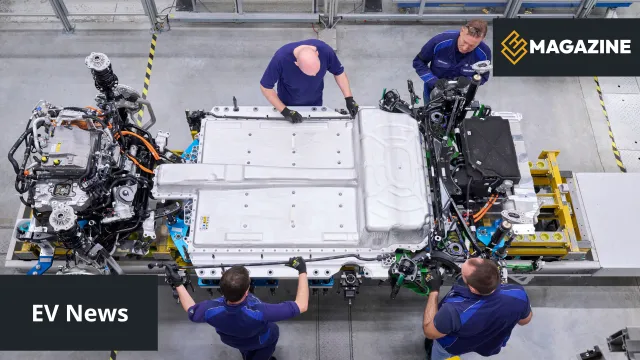
The Energy Innovation Square is described by Panasonic as a global hub for battery development and production. In practice, that means one campus covering material development, cell design, prototype construction and the subsequent analysis. Around 500 people work there. The Suminoe facility, also in Osaka, handles manufacturing technology — together the two sites employ roughly 800 people.
The logic is consolidation. Development work that used to be spread across several locations now sits in one place, which Panasonic expects to shorten development times, transport included, by more than 15%. The company also leans on digital methods: simulation data and physical test results are merged and evaluated through continuous process monitoring and statistical analysis, so the models improve and a new cell reaches mass production faster.
The deadline is the fiscal year ending March 2031, when Panasonic wants to have doubled development efficiency against fiscal 2024.
The 15% figure, translated
A new cell generation normally takes four to six years from laboratory to series production. Fifteen per cent off a five-year cycle is roughly nine months — nearly a whole model year. For an automaker planning a facelift or a new platform, that is the difference between launching with a competitive pack and arriving a year late.
One caveat: Panasonic does not define what "development efficiency" means, and doubling an undefined metric over seven years cannot be verified from outside. Treat it as a target, not as data. What can be verified is the headcount, the buildings and the cells that eventually land in customers' cars.
3.7% against CATL's 39.2%
According to SNE Research, Panasonic held 3.7% of the global EV battery cell market in 2025, while CATL took 39.2% and BYD 16.4%. Panasonic ranked behind CATL, BYD, LG Energy Solution, CALB, Gotion High-Tech and SK On — seventh place in a market where the top two alone control 55.6% of installations.
Put differently: CATL is roughly 10.6 times larger than Panasonic in EV cells. To pull level, Panasonic would have to multiply output more than tenfold from a footprint that today means Japanese plants plus Nevada and the Kansas site under construction. Kadoma will not change that arithmetic by itself. What it can do is make each generation cheaper to develop and quicker to launch — the only lever a smaller player really has.
Energy density, lifespan and the 4680
Panasonic names higher energy density and longer lifespan as the key automotive requirements, with the 4680 cylindrical format as the vehicle for both. The Himeji plant in Japan has been ramping that format; the Kansas factory and the long-standing Nevada operation with Tesla complete the picture. Panasonic has also signed supply agreements with Subaru, Mazda and Lucid, part of a slow effort to reduce its dependence on a single customer.
Rough arithmetic on density: if the same pack volume gains 5% usable energy, a 77 kWh pack becomes roughly 81 kWh. At a real-world consumption of 18 kWh/100 km that is about 428 km versus 449 km — some 21 km extra, or 5% more range, from nothing but the cell. Real cars rarely deliver the brochure figure, so check what independent testing measured in our real-world range calculator based on Bjørn Nyland's data.
The race is not only about density. Our report on BMZ Poland and EVE's LMFP truck battery — 10% lighter, 1 MW charging, 4,500 cycles — shows how hard the competition is pushing on cycle life and cost. A cell developed in Kadoma will also have to survive contact with a real charger, which is exactly what tests like our Mercedes CLA charging test, 10–80% in 26 minutes, are for.
Data centres: the second leg
Panasonic explicitly targets data centres alongside cars. The reasoning is the AI build-out — racks and grid-support systems need high-performance batteries, and that demand is growing faster than EV demand in several markets. The priorities differ, though: stationary storage cares more about cost per cycle and calendar life than about kilograms. That gives Panasonic a hedge if car sales stay flat in Europe and North America.
Where Europe fits
Panasonic has no cell production in Europe. Supply here is dominated by LG Energy Solution in Poland, Samsung SDI and SK On in Hungary, CATL in Hungary and its Spanish joint venture with Stellantis, plus Chinese LFP imports — and the collapse of Northvolt in 2025 removed the largest European-owned project. Cells developed in Kadoma will therefore reach European customers inside cars, not inside European factories. One trade detail worth noting: the EU–Japan EPA removes the remaining EU tariff on Japanese passenger cars by 2027, which helps Japanese-built EVs but says nothing about where the cells come from.
What it means in euro per 100 km
Cell research shows up in your wallet slowly. Today's numbers: a compact EV consuming 18 kWh/100 km costs €4.50 per 100 km charging at home at €0.25/kWh, and €10.62 per 100 km on DC at €0.59/kWh — a price within the band our database of 483 supercharger locations shows across Europe. A petrol compact at 6.5 l/100 km and €1.55/l comes to €10.08. DC-only driving is therefore roughly at parity with petrol, while home charging is about 2.2× cheaper. Check your own mix in our charging cost calculator and find the cheapest DC prices on our cheapest superchargers list. Longer cell life shifts the other half of the equation: a pack lasting 500,000 km instead of 300,000 spreads its purchase cost over 67% more distance.
Infrastructure is not free either — our coverage of EZO raising €150 million for 3,000 UK and Ireland charge points, at €50,000 each, is a reminder of where European money is currently going.
What to watch
Three things. Whether the Kansas plant ramps on schedule and gives Panasonic volume outside Japan and Nevada. Whether the next 4680 iteration delivers measurable energy density rather than another laboratory claim. And whether Panasonic announces a European customer — without one, its cell business stays structurally dependent on Tesla and a handful of Japanese automakers.
For buyers, nothing changes in 2026. Cells from this pipeline arrive in cars in the early 2030s, so decisions made today should rest on measured range and charging curves, not on R&D press releases. Panasonic has not said which cell generation leaves Kadoma first, or which customer gets it. That is the number worth waiting for.
Source: https://www.electrive.com/2026/09/17/panasonic-energy-opens-battery-development-centre-in-osaka/