
Listen to this article:
From slow June to swift comeback
June was uncomfortable reading for Nio. The company delivered 8,969 ES8 units that month — a 21.85% drop compared to May — ending a run of seven consecutive months in which the premium SUV had exceeded 10,000 deliveries. Analysts and investors noticed, and questions surfaced about whether the third-gen ES8, launched in late September 2025, was running out of steam.
The answer, it turns out, was simpler than a fundamental demand problem. Potential buyers were holding off, waiting for a configuration that did not yet exist: a five-seat version. Nio launched it on July 9, 2026, with first deliveries following the very next day. The response has been sharp enough to push the cumulative total toward 130,000 units by the week of July 20 — adding roughly 10,000 deliveries in a single month after the June dip.
Why the five-seat version matters
The original third-generation ES8 came in six- and seven-seat configurations, targeting families and executives who needed the full three-row layout. That left out a significant group of Chinese premium SUV buyers who prefer the roomier second-row experience of a five-seat arrangement — typically younger urban couples or small families who never use a third row but do want more rear legroom and a cleaner cabin aesthetic.
Nio has priced the five-seat ES8 at 382,800 yuan (approximately $56,500) — around 5.9% below the three-row variants. Under Nio's Battery as a Service (BaaS) scheme, where buyers lease the battery rather than own it, the entry point drops to 274,800 yuan, bringing monthly costs closer to conventional premium car finance deals in China. BaaS remains one of Nio's most distinctive commercial offers: it lowers upfront cost, gives owners access to battery swapping infrastructure, and allows upgrades to future battery technology without replacing the car.
High margins, rising costs
The ES8 occupies the top of Nio's product range and is described by the company as a high-margin model. That makes its delivery trajectory important not just for brand image but for financial performance. CEO William Li has acknowledged that raw material prices have added nearly 20,000 yuan to the cost of producing each ES8 — a pressure he described as manageable but real.
Nio's main brand recorded an average transaction price of 443,000 yuan in June 2026, which translates to roughly €56,000 at current exchange rates. That positions it firmly against Audi, BMW, and Mercedes-Benz in the premium segment — a deliberate strategy that distinguishes Nio from the volume-first approach of its own sub-brand Onvo.
What the third-gen ES8 actually is
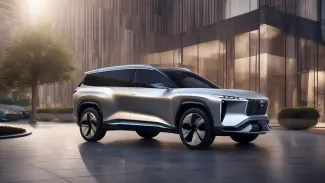
For readers more familiar with the European market, the ES8 is sold on the continent under the name NIO EL8. The platform is essentially the same: a large luxury SUV measuring 5,099 mm in length on a 3,070 mm wheelbase, powered by a dual-motor all-wheel-drive system delivering 180 kW at the front and 300 kW at the rear. The combined output accelerates the vehicle to 100 km/h in 4.1 seconds.
European EL8 buyers get a WLTP-certified range of approximately 510 km on a 100 kWh battery pack, with energy consumption between 21.2 and 23.1 kWh per 100 km. The body structure is 90.5% aluminium alloy, contributing to a torsional stiffness of 39,400 Nm/deg — figures that rival dedicated sports cars. The cabin features dual-chamber air suspension, 33 integrated cameras and sensors, and over-the-air upgradeable seat calibration.
The bigger picture: Nio's three-brand strategy under pressure
The ES8 milestone arrives at a moment when Nio is managing simultaneous growth across three brands: the flagship Nio marque, the mass-market Onvo, and the forthcoming Firefly sub-brand targeting younger, urban buyers. Sustaining the ES8's premium positioning while scaling cheaper vehicles without cannibalising the flagship is a challenge every established carmaker has faced — and few have navigated cleanly.
In Europe, Nio has been methodically expanding its retail presence, including a recently opened store in Athens. Norway, Germany, the Netherlands, Denmark, and Sweden remain the core markets, where the EL8 competes directly against the Audi Q8 e-tron and BMW iX. The 130,000th ES8 delivery this week is, among other things, a signal to European partners that demand for the platform remains robust — even if it took a new seating configuration to prove it.
What is the difference between the Nio ES8 and the NIO EL8?
They are essentially the same vehicle. In China it is sold as the ES8; in Europe it is marketed as the EL8. The specifications are closely aligned, with the European version rated for approximately 510 km of WLTP range and featuring local adaptations for EU market requirements.
What is Nio's Battery as a Service (BaaS) programme and how does it work?
BaaS allows buyers to purchase a Nio vehicle without the battery pack, paying instead a monthly subscription fee. The battery can be swapped at Nio's Power Swap Stations in minutes rather than charged conventionally, and owners can upgrade to newer, higher-capacity batteries in the future without buying a new car. It lowers the purchase price significantly — in the case of the five-seat ES8, from 382,800 yuan to 274,800 yuan.
Is the five-seat ES8 variant available in Europe?
As of July 2026, the five-seat configuration launched in China. Nio has not yet announced whether this specific variant will be offered under the EL8 nameplate in European markets, where the current lineup focuses on six-seat and seven-seat configurations.
Source: https://cnevpost.com/2026/07/20/nio-to-deliver-130000th-new-es8-this-week/