Three Deals, $2.578 Billion, One Pattern
The story has played out three times in the span of just a few months in 2026, each time with the same structure: an energy company holds an offshore wind lease, the Interior Department under Secretary Doug Burgum agrees to buy back that lease at full price, and the company pockets the money while killing clean energy development in the process.
The three deals, totalling $2.578 billion, broke down as follows:
- March 2026 — TotalEnergies received nearly $1 billion to cancel its offshore wind leases
- April 2026 — A second, unnamed company received $885 million in a similar arrangement
- June 2026 — Invenergy was paid $765 million to abandon four offshore leases: one off the New York/New Jersey coast, one in California, and two off Maine
Each payment was made through the Judgment Fund — a federal fund legally designated for settling actual government lawsuits. The problem, legal critics point out, is that no lawsuits were ever filed. Internal communications obtained by reporters suggest that in at least one case, Interior Department officials had already decided on the billion-dollar payment before any legal claim existed — essentially creating a justification after the fact.
Who Is Doug Burgum — and Why Does It Matter?
The architect of these deals is Interior Secretary Doug Burgum, a former North Dakota governor with deep ties to the fossil fuel industry. Critics note that Burgum has received hundreds of thousands of dollars in campaign contributions from oil and gas interests. His department's approach to offshore wind since taking office has been consistent: halt new projects, unwind existing leases, and now — pay companies to leave.
The Invenergy deal, announced in June 2026, is particularly striking. The four leases being cancelled include sites off the coast of New York and New Jersey — some of the most densely populated areas of the United States, where electricity demand is high and grid pressure is growing. Those sites had been approved for development following years of environmental review and Defense Department security clearances.
That last detail matters: officials have cited national security as a justification for cancelling wind projects. Yet those same projects had already been cleared by the Department of Defense. When previously approved clean energy infrastructure is retroactively deemed a security risk, the reasoning starts to look circular.
The Real Cost: Higher Electricity Bills
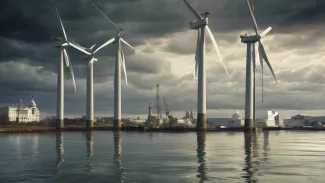
Offshore wind is not a niche product. In both the US and Europe, it has become one of the cheapest forms of new electricity generation at scale. Cancelling these projects does not simply eliminate supply from one type of energy — it reduces overall generating capacity at a moment when US electricity demand is growing at its fastest pace in decades, driven largely by data centres, AI infrastructure, and the electrification of transport.
For EV drivers, this matters directly. The economic case for electric vehicles rests partly on cheap, abundant electricity. If offshore wind projects are cancelled, the grid becomes more dependent on natural gas — a fuel whose price is volatile and heavily influenced by global commodity markets. The result, over time, is higher electricity prices for households and businesses alike.
Wind energy, by contrast, has zero fuel cost once the turbines are built. The more wind capacity on a grid, the more downward pressure it places on wholesale electricity prices. Removing that capacity — and paying over $2.5 billion to do so — works in precisely the opposite direction.
The Judgment Fund Controversy
Legal scholars have raised sharp questions about whether these payments were lawful. The Judgment Fund was designed to pay damages when the US government loses a lawsuit. Using it to pre-empt lawsuits that were never filed, for agreements that function more like policy buyouts than legal settlements, is, critics argue, a misuse of public money.
The term "bribe" is inflammatory, and the companies receiving the payments would reject it — they entered into agreements with the government on commercial terms. But the substance of the arrangement is hard to characterise differently: public money, drawn from a legally constrained fund, was used to pay private energy companies to not build clean energy infrastructure and to redirect their investment toward fossil fuels.
For European observers, this pattern has a familiar shape. Subsidising incumbents to stall competition is not a new tactic in energy policy. What makes the American version unusual is the scale — nearly $2.6 billion in less than four months — and the speed at which it has accelerated.
What Comes Next
Environmental groups, several US states, and Democratic lawmakers are already calling for congressional investigations. New York and New Jersey, both of which have aggressive clean energy targets, are watching the Invenergy deal with particular concern: the cancelled leases off their coasts had been expected to supply power to millions of homes.
For the offshore wind industry globally, the message from Washington is clear: the United States is, for now, closed. European developers — many of whom hold or held US leases — are reading the situation carefully. Some, like TotalEnergies, have already taken the buyout money and left. Others may follow.
What is certain is that the electricity consumers will eventually feel these decisions. Grids do not lie about supply and demand. When cheaper generation sources are removed and more expensive ones remain, the bill arrives — not to energy companies or their executives, but to the people who pay their electricity tariffs every month.
Is it legal for the US government to use the Judgment Fund to buy back offshore wind leases?
The Judgment Fund is legally designated for settling actual government lawsuits. Critics and legal scholars argue its use in these deals is improper because no lawsuits were ever filed — the payments appear to have been structured as pre-emptive settlements to avoid litigation that had not yet materialised, and internal documents suggest the decisions were made before any legal claim existed.
How do offshore wind cancellations affect EV drivers and electricity prices?
Offshore wind produces electricity at very low marginal cost — the wind is free once the turbines are built. Cancelling wind projects removes cheap generation capacity from the grid, making it more dependent on natural gas, which has volatile fuel costs. This generally leads to higher wholesale electricity prices over time, directly increasing the cost of charging electric vehicles.
Which offshore wind leases were cancelled under the Invenergy deal in June 2026?
Invenergy agreed to abandon four leases in exchange for $765 million: one off the coast of New York and New Jersey, one in California, and two off the coast of Maine. These leases had previously passed environmental review and received security clearance from the US Department of Defense.