Listen to this article:
When China's EV market exploded over the past three years, the established joint ventures — Toyota-GAC, Volkswagen-SAIC, Nissan-Dongfeng — looked like slow-moving relics. Local brands such as BYD, Xpeng, Li Auto and NIO dominated the new energy space, while the JVs struggled to adapt their global platforms, model cycles and supplier networks to a market that had simply moved faster than anyone expected.
The numbers were stark: in March 2025, mainstream joint venture brands collectively achieved only a 6% new energy vehicle penetration rate, compared to 72% for Chinese-owned brands. It looked less like a competition and more like a rout.
The N7: Born Chinese, Made for China
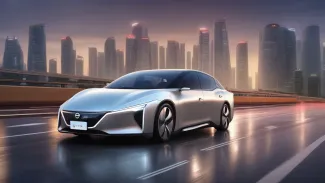
Dongfeng Nissan's response was the N7 — but with a crucial difference from previous JV attempts. Rather than adapting a global platform, the N7 was the first Dongfeng Nissan model designed and developed entirely by a Chinese team. Launched in late April 2025 with a starting price of 119,900 yuan (approximately €15,800) and topping out at 149,900 yuan, it was priced aggressively enough to go head-to-head with Xpeng's popular Mona M03 sedan.
The technology stack was equally local. The N7's cockpit integrates DeepSeek-R1, the AI large language model that stunned the global tech world with its efficiency earlier in 2025, while the driver-assistance suite was developed in partnership with Momenta, one of China's leading autonomous driving startups. This wasn't a Japanese car with a Chinese badge — it was a genuinely China-first product.
Peak monthly sales reached 10,148 units in August 2025, a strong result for a brand-new model in one of the world's most competitive car markets. By May 2026, monthly sales had settled to around 1,447 units as the product line expanded and buyers' attention shifted to newer N-series additions.
Three Models, a Platform, a Strategy
Dongfeng Nissan quickly followed the N7 with two more vehicles. In December 2025, the N6 plug-in hybrid sedan arrived, starting at 91,900 yuan — broadening the lineup to include buyers who want electrification without range anxiety. Then, in April 2026, came the NX8 EREV (Extended-Range Electric Vehicle), a mid-to-large SUV targeting the premium family segment.
The NX8's reception was remarkable: it attracted 8,423 pre-orders within just 30 minutes of launch — a metric that Chinese brands frequently use as a proxy for market enthusiasm, and one that Dongfeng Nissan can now credibly claim for itself.
Together, these three models pushed the cumulative N-series production count past 100,000 units in approximately 14 months — a pace that signals genuine consumer acceptance, not just initial curiosity.
A Market Warming to JV EVs
Dongfeng Nissan's results are part of a broader shift. By May 2026, joint venture brands collectively reached a 14.5% NEV penetration rate, up from just 6% fifteen months earlier. While that figure still trails Chinese-owned brands by a significant margin, the trajectory matters: JV brands appear to have absorbed the lesson that competing in China means building for China — on price, on technology, and on the AI-defined in-car experience that local consumers increasingly expect as standard.
Volkswagen, Toyota and others are pursuing similar strategies, investing in local partnerships for software stacks and rapidly localising model development. For European customers watching from afar, the trend is worth noting: the same competitive intensity that is reshaping China's domestic market is also shaping what these brands can offer globally.
The Rivalry Turns Contentious
Rapid growth in a hyper-competitive market rarely goes smoothly. The NX8 launch in April 2026 triggered an unusually public dispute: Li Auto's CEO publicly accused Dongfeng Nissan of orchestrating social media accounts to "maliciously smear" his company during the NX8's market entry. The allegation escalated quickly enough that China's Ministry of Industry and Information Technology intervened, summoning representatives from both companies for talks.
The episode highlights the pressure under which even successful players are operating. In a market where a product launch can generate thousands of pre-orders in 30 minutes, every competitor is watching — and prepared to react. Whether the dispute reflects dirty tactics or hypersensitivity in a fragile competitive moment, it shows that the JV comeback is being felt where it matters: in the sales figures of rival brands.
What It Means for Nissan Globally
Nissan's broader position makes this milestone more significant than a simple production number. The Japanese automaker has faced difficult years, navigating a failed merger with Honda, restructuring programmes, and declining global market share. China remains its largest single market, and the Dongfeng partnership accounts for a substantial portion of its global volumes.
A locally-designed, AI-equipped, competitively priced electric lineup that resonates with Chinese buyers is not just good news for the joint venture — it is a lifeline for Nissan's medium-term viability in the world's largest automotive market. The 100,000-unit milestone won't reverse years of structural challenges overnight, but it demonstrates that a pragmatic pivot toward local design leadership and technology partnerships can produce real results, fast.
For European observers, the Dongfeng Nissan story offers a preview of the competitive pressure that will eventually arrive closer to home — both from Chinese brands themselves, and from JV models developed with the same local-first approach that made the N7 and NX8 possible.
What is the Dongfeng Nissan N-series and which models does it include?
The N-series is Dongfeng Nissan's new energy vehicle lineup designed and developed by its Chinese team specifically for the Chinese market. As of mid-2026, it includes the N7 electric sedan (launched April 2025, from 119,900 yuan), the N6 plug-in hybrid sedan (December 2025, from 91,900 yuan), and the NX8 extended-range electric SUV (April 2026).
Why are joint venture brands doing better in China's EV market in 2026?
JV brands have shifted strategy by developing models locally — tailored to Chinese price points, aesthetics and technology preferences — rather than adapting global platforms. Integration of local AI systems like DeepSeek and partnerships with Chinese autonomous driving startups such as Momenta have been central to this change. The result is products that Chinese consumers find genuinely competitive, not merely sufficient.
What is an EREV, and why is the NX8's EREV technology significant?
An extended-range electric vehicle (EREV) runs primarily on an electric motor powered by a battery, with a small petrol engine acting as a generator to recharge the battery when needed — rather than driving the wheels directly. This approach, popularised in China by Li Auto, eliminates range anxiety while keeping the primary driving experience electric. The NX8 entering this segment signals that JV brands are now competing directly in one of China's fastest-growing EV categories.
Source: https://cnevpost.com/2026/06/12/dongfeng-nissans-n-series-nev-output-hits-100000/