
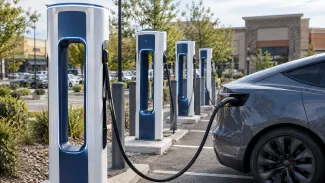
Twelve posts in Illinois
The site sits on property owned by real estate company Regency Centers, which has worked with EVgo on charging before. The posts are Tesla V4 units, bought through Tesla's Supercharger for Business programme and shown in EVgo's app as "EVgo Superchargers". EVgo announced the programme in August 2026 and said then that individual sites could reach 20 charging points. The first one has twelve.
Ownership decides the tariff. EVgo owns and operates the hardware, so these stalls do not have to match the price of a Tesla-owned site a few kilometres away. Tesla cars see the location in the in-car navigation and Trip Planner, the same way regular EVgo stations with NACS connectors have appeared there since early September, provided third-party charging is enabled in the car.
What the V4 posts can deliver
Tesla quotes up to 500 kW per post and up to 1,000 V. Those are cabinet ceilings, not a promise to the car. A 400 V pack cannot use 1,000 V architecture, and most current models peak well below 500 kW in any case. Twelve posts at 500 kW add up to 6 MW of theoretical site capacity, which no realistic grid connection beside a supermarket will supply. Expect shared power and a taper after roughly 60 to 80% state of charge, as on any other fast-charging site.
The Magic Dock does the practical work. It lets both NACS and CCS cars charge without carrying their own adapter, and the longer V4 cables help with the awkward port positions some models still have. That is a smaller problem in Europe, where Tesla sites have offered CCS2 plugs since the network opened to other brands.
NACS connectors across the network
By the end of 2026 EVgo wants 500 NACS charging points nationwide. Within two years, every EVgo site built in 2023 or later should have at least one NACS connector. The Tesla-built posts are meant to sit alongside that in-house work rather than replace it. EVgo has not published how many additional Supercharger sites will follow, or when.
Prices and how to compare them
EVgo sets the tariff at the Chicago site and did not publish a per-kWh figure in the announcement. Without a number there is nothing to compare, which is why our supercharger database keeps 483 European locations with the price recorded at each, and the cheapest ones on a separate page. The arithmetic is simple and unforgiving: a car using 20 kWh/100 km pays €10 per 100 km at €0.50/kWh, and €7.80 at €0.39/kWh. Our charging cost calculator runs that for your own consumption and tariff.
Access only matters if the credit behind it is usable. We reported earlier that BMW gives US buyers of the i5, i7 and iX3 $500 in public charging credit; networks that a car can actually reach decide whether such offers are worth anything.
The European version of the same problem
Europe's connector question is mostly settled. The payment question is not. Since 13 April 2024, new public fast-charging points above 50 kW in the EU must accept ad-hoc card payment under AFIR, without an app or a subscription. Build-out targets are the slower part: we looked at Ireland's 280 MW charging network for 2028, which sits below the AFIR benchmark. A single twelve-post site in Illinois would not move that number much either.
What a driver should do with this
Three practical points. First, check the connector type before planning a route, because a NACS stall is not yet guaranteed at every third-party site. Second, do not read 500 kW as your car's charging speed; the vehicle's own curve sets that. Third, compare tariffs per kWh rather than per minute, since a slow car on a fast post is the most expensive combination there is.
For European drivers the useful reference remains the price map rather than the Chicago opening. Our range calculator and the real-world range tool built on Bjørn Nyland's measurements answer the other half of the question: how far a given car actually goes between stops. EVgo, for its part, has confirmed the first site and the 500-NACS-point target, and left the rest of the schedule open.
Source: https://www.electrive.com/2026/11/06/evgo-integrates-first-tesla-superchargers-into-its-network/