
What the record does and does not change for Europe
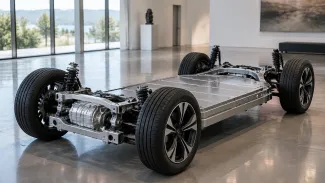
Ferrari’s first production Luce chassis, ZFF21BUA8T0338000, was sold without reserve and with the buyer’s premium waived, so the reported $40 million hammer price is also the charitable donation, according to Electrek’s report from Monterey. For European reservation holders, the result does not change the official Luce price of €550,000, and it does not accelerate the first customer deliveries expected from the first quarter of 2027.
It does, however, reinforce that Ferrari has turned the first BEV in its history into a collector object before independent technical data exists. The buyer receives a one-off Tailor Made specification with a very significant chassis number, and the completed car will follow after final assembly in Maranello. That is a useful reminder to separate auction theatre from a production EV.
The arithmetic is real; the market signal needs caution
The pre-sale estimate was $1.1 million, so the result is roughly 36.4 times the estimate. At the official €550,000 list price, or about $640,000, the hammer sum also works out to 62.5 times the sticker. Ferrari also exceeded its own recent Monterey charity record: a one-off Daytona SP3 reportedly sold for $26 million in 2025, so the increase to $40 million is $14 million, or 53.8%.
Those figures are remarkable, but they tell us almost nothing about residual value for a regular-production Luce. A charity lot has no conventional price ceiling: the bidder can value the vehicle, the occasion, publicity and the donation separately. Ferrari reportedly sold its 2026 Luce allocation—just under 500 cars—before delivery. That is a more meaningful demand signal, though still not an independent technical result.
For an EV, the technical questions remain unanswered
Ferrari has not yet put enough independently measured Luce data into public hands for a serious verdict on usable battery capacity, DC charging curve, motorway consumption, winter range or repeatable acceleration. Official range figures are useful, but the important number is what happens at 130 km/h in cold weather, with cabin heating running and after several rapid-charge sessions. Until independent tests arrive, any claim that the Luce is technically a success—or a failure—is ahead of the evidence.
Battery ageing is equally relevant to collectors who may be tempted to store the car. Our coverage of a Tesla Model 3 LFP with 78,000 miles and 92% measured battery health is a useful reminder that real battery condition comes from measurement over time, not from a badge or a launch presentation. The Luce will use a very different, performance-focused battery system, so the Tesla result cannot be transferred to Ferrari; it simply illustrates why data should win over assumption.
A €550,000 EV still has to charge like an EV
At normal Luce money, the practical ownership calculation is far less glamorous than a $40 million charity auction. Owners will need home charging, dependable high-power public charging on European touring routes, and transparent pricing. Our Supercharger database currently tracks 483 European locations and their charging prices; a high-end EV does not make the price per kWh disappear, although its owner may be less likely to notice it.
Before ordering any EV, use our charging cost calculator with your home tariff and likely public-charging price rather than relying on a headline claim. For the Luce specifically, buyers should wait for confirmed usable-kWh, peak-kW and 10–80% charging-time figures before attempting a meaningful cost-per-100-km calculation.
There is also a wider contrast worth noting. While Ferrari’s first EV is being sold as a scarce collector object, battery infrastructure is becoming increasingly ordinary. China’s battery-swap build-out has passed 4,000 stations in Nio’s network, as we covered when Nio launched its fifth-generation swap stations. Ferrari is selling rarity; the broader EV market is working on repeatability, uptime and cost.
The sensible conclusion
Chassis 0 is an extraordinary charitable auction result and a symbolic moment for Ferrari’s electric programme. It is also a car whose road-going credentials have not yet been independently established. The buyer acquired a unique first Ferrari BEV and a historic serial number. Prospective Luce customers should acquire something less emotional: verified range, verified charging data and a contract that clearly states delivery and specification.
For now, $40 million proves that Ferrari can create collector demand around its first EV. It does not prove how far the Luce goes in winter, how quickly it recovers range on a motorway stop, or whether it will be the electric grand tourer enthusiasts expect. Those are the numbers that will matter once Chassis 0 leaves Maranello.
Source: https://electrek.co/2026/08/16/ferrari-luce-chassis-0-sells-40-million-record/