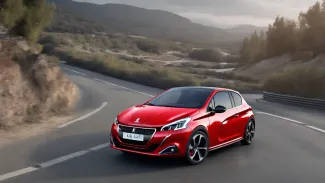
A Legend Reborn for the Electric Age
There's a weight of expectation on the E-208 GTi that few cars ever carry. The original Peugeot 205 GTi didn't just sell well — it created a genre. Drivers who grew up hustling those nimble hot hatches through country lanes and city streets have been waiting, with a mixture of anticipation and anxiety, for Peugeot to make good on the GTi name in the electric era.
The answer, it turns out, is surprisingly convincing. The E-208 GTi uses a new M4+ electric motor, producing 207 kW of power and 345 Nm of torque — figures that put it firmly in hot hatch territory and well beyond most family superminis. The motor drives the front wheels, staying true to the GTi formula.
Performance That Earns the Badge
Numbers on paper only tell part of the story, but in this case they tell a very good one. The E-208 GTi sprints from 0 to 100 km/h in 5.5 seconds — a figure that would have been considered supercar-adjacent just a decade ago in this class. The 80–120 km/h overtaking time of 3.2 seconds is the one that matters most on European roads: the in-gear response that separates truly quick cars from merely fast ones.
Top speed is electronically limited to 180 km/h, which is sensible for a front-wheel-drive hatchback. The standing kilometre benchmark — a favourite metric for track day enthusiasts — falls in 25.8 seconds.
Crucially, Peugeot has reworked the battery management system specifically to support the M4+ motor's demands. The team focused on coolant flow strategy to ensure the battery can consistently deliver maximum performance — not just for a single sprint, but across repeated hard acceleration. This is where electric hot hatches have historically struggled: thermal management under sustained performance driving. Peugeot's engineers appear to have taken that challenge seriously.
Battery and Range
The E-208 GTi carries a 54 kWh gross battery pack, with 51 kWh of usable capacity. WLTP range is rated at 374 kilometres — a respectable figure for a performance-oriented compact electric car. In real-world spirited driving, expect somewhat less, as the M4+ motor's power delivery will invite enthusiastic use of the throttle.
This is a car that asks you to drive it, not coddle the range meter. The trade-off between performance and efficiency is one every driver in this segment will navigate consciously — and for most, the performance will win.
Shared DNA, Distinct Character
The E-208 GTi shares its technical platform with the Opel/Vauxhall Corsa GSE, Peugeot's sister brand under the Stellantis umbrella. Both cars use the M4+ motor and the same basic architecture — a development approach that makes commercial sense and allows both brands to bring genuine performance to market efficiently.
What distinguishes the E-208 GTi is the Peugeot-specific tuning and the weight of that GTi heritage. The visual identity carries subtle but clear performance signals — this is not a standard e-208 with a badge upgrade. Peugeot unveiled the concept at the Paris Motor Show in June 2025, building anticipation over twelve months before opening orders.
Pricing in Context
At €42,900 in France, the E-208 GTi enters a segment that is still finding its feet. The Volkswagen ID.3 GTX starts at comparable money. The Renault 5 Alpine is expected in a similar bracket. The Cupra Born VZ represents another rival in the performance electric supermini space.
In the UK at £34,995, the E-208 GTi faces the challenge all premium small EVs face: justifying the premium over combustion alternatives. But for buyers who want a genuine hot hatch — sharp steering, strong acceleration, a car that responds to driver inputs — the electric GTi offers something increasingly rare: performance with a purpose-built character rather than generic EV pace.
The absence of combustion engine noise is not, in this case, a simple loss. Peugeot has had to think carefully about how the car communicates with its driver through other means — through chassis feedback, steering weight, and the immediate torque delivery that electric motors uniquely provide. How well that synthesis works in practice will be confirmed by first drives in the coming months.
What It Means for the Hot Hatch Segment
The electric hot hatch was, for years, a theoretical proposition. Batteries were too heavy, range too short, and performance cars too niche to justify the engineering investment. That equation has shifted. The E-208 GTi, alongside the Renault 5 Alpine and VW ID.3 GTX, signals that the performance supermini is finding its electric footing.
For European drivers under 40 who grew up with the GTi mythology but entered the car market in the electric age, the E-208 GTi could represent the first genuine convergence of what they were told hot hatches were, and what they actually want from a car today. That is no small thing.
How does the Peugeot E-208 GTi compare to its petrol predecessor in performance?
The E-208 GTi's 207 kW (281 hp) electric motor and 5.5-second 0-100 km/h time significantly outpace the previous petrol 208 GTi, which produced around 200 hp and took approximately 6.5 seconds to reach 100 km/h. The instant torque delivery of electric power makes the new car feel faster still in everyday driving conditions.
Is the E-208 GTi available across all European markets?
At launch in June 2026, Peugeot has confirmed availability in France (€42,900) and the UK (£34,995). Broader European market availability and pricing are expected to be confirmed in the coming months. Buyers in other markets should check with their local Peugeot dealership for timelines.
How does the E-208 GTi handle thermal management for performance driving?
Peugeot has specifically reworked the battery management system's coolant flow strategy for the M4+ motor, aiming to ensure consistent maximum performance delivery across repeated acceleration runs — addressing one of the key challenges for electric performance cars on track days and spirited driving routes.
Source: https://www.electrive.com/2026/06/12/peugeot-e-208-gti-starts-at-e42900/