
What changes at the cell level
In a pack built today, the cells sit in one series string. A 400-volt-class pack with roughly 96 cells in series runs from about 400 volts at full charge down to about 290 volts when empty, and everything downstream is designed for that spread: the inverter, the charger, the DC-DC converter. A weak or aged cell adds resistance and drags the whole string with it.
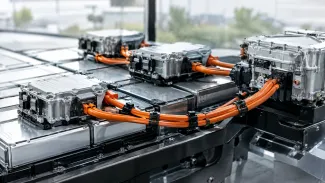
Mercedes' Power Converters break that link. Each module looks after a single cell or a small cluster, and several of them in parallel keep the DC output at a fixed 800 volts. The control software can relieve a weaker cluster instead of letting it throttle the pack. According to Mercedes, AC charging, DC charging and bidirectional operation can all be handled inside the converters.
Three kilowatts per module
The 3 kW figure is where the arithmetic gets interesting. A European three-phase wallbox at 11 kW would, if the modules simply add up, need four of them running flat out. A 250 kW DC peak would take about 83. Mercedes has not said how many modules a pack carries, nor how much of the traction current actually passes through them. If they only shift energy between clusters rather than feeding the motor directly, the count looks very different. That distinction decides whether this is a modest addition of power electronics or a rebuild of the pack's electrical layout.
The on-board charger goes away
An 11 kW three-phase on-board charger is standard equipment on European EVs, with 22 kW as an option. Folding that function into the cell-level converters saves weight, space and bill-of-materials cost, which is the part of the announcement with the clearest production logic behind it.
The traction inverter gains as well. It always sees 800 volts at its input, so it can be optimised for one operating point instead of tracking a moving voltage. Mercedes also points out that identical powertrain components can then be used across different drivetrain concepts. The company has not published an efficiency figure for the gain.
800-volt cars exist already, a fixed 800 volts does not
Porsche's Taycan, the Hyundai Ioniq 5, the Kia EV6 and the Audi Q6 e-tron all run 800-volt packs. Their terminal voltage still follows the cells up and down, and their charging power still tapers through a session. Some of that taper comes from chemistry and temperature and cannot be engineered away by holding the bus steady. A charger feeding a fixed 800-volt bus would at least work at one voltage for the whole session rather than following the pack.
There is a second effect. Many DC chargers in Europe still deliver 400 volts, so an 800-volt car has to boost internally. Mercedes says DC charging can be integrated into the Power Converters, which would remove a separate boost stage. How that works in practice is not described.
Repair, service and paid unlocks
Putting switching electronics on every cell cluster moves complexity inside the pack. Mercedes' own announcement leaves the repair question open. A pack that needs a converter module replaced is a different service job from a pack that needs a module of cells swapped.
The software side is clearer. If bidirectional charging and maximum charging power are set by the converters, both can be enabled or limited over the air. That gives the manufacturer a technical basis for paid upgrades after purchase, the same model already used elsewhere in the industry for performance and charging features. Buyers of used cars would need to know which licences travel with the vehicle.
What a buyer should take from it
Nothing to act on yet. This is a development architecture, not a car on a price list, and Mercedes has not said when it reaches series production. The relevant question for now stays the same as for any 800-volt model: look at the 10 to 80 percent charging time, not the peak kilowatt headline.
For context on what DC charging costs on European routes, our supercharger database lists 483 locations with prices, and the charging cost calculator converts a given consumption and tariff into euros per 100 km. The cell-level electronics Mercedes is describing also add semiconductor content to every pack, which matters more as cell supply concentrates: Chinese manufacturers held 73 % of the global EV battery market, as we reported. On the charging side, Mercedes has been shedding infrastructure rather than building it, having sold 47 European charging sites to Electra.
The announcement names no model, no date and no cost per converter. The service and repair consequences of putting power electronics on every cell cluster remain the open item.