
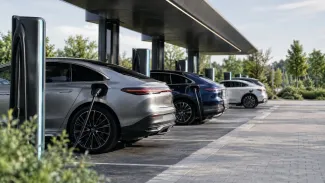
Mercedes charging hubs move to Electra
Mercedes-Benz confirmed the sale in its third-quarter financial reporting, placing the assets connected with its European charging business at €99 million. The buyer is Electra, a French charge-point operator that is expanding across several European markets.
The 47 former Mercedes locations contain 374 fast-charging ports. That works out at almost eight ports per location. The sites have now been integrated into Electra’s network, according to reporting by Electrive. Branding and payment terminals are due to change.
For a driver, this is a change of operator rather than the closure of 47 charging parks. Mercedes says its electric-car customers will retain preferential access through the company’s charging services. Electra becomes a “Premium Partner”, behind Ionity in the Mercedes partnership structure.
A small network joins a much larger one
Electra says Mercedes customers can receive discounted charging at more than 5,000 Electra charge points at 800 locations. The acquired Mercedes estate represents just under 6% of Electra’s roughly 800 locations, while the 374 former Mercedes ports account for around 7.5% of the 5,000-plus connectors cited by the companies. It is a meaningful addition, particularly because the Mercedes sites were built as high-power hubs rather than individual chargers in car parks.
The original Mercedes network was intended to offer a predictable stop on longer trips, with many locations using 400 kW hardware from Italian supplier Alpitronic. Mercedes had previously stated a global ambition of more than 10,000 fast chargers by the end of the decade. That plan now looks different in Europe: the carmaker will sell access and integrate partners, rather than own the sites itself.
Scale matters in public charging. A smaller operator must still pay for grid connections, land, maintenance, payment systems and customer support. A larger provider can spread those costs across more locations and may have a stronger case when negotiating electricity purchases or new sites. That does not automatically mean lower prices at every charger; drivers should still check the tariff before plugging in.
Our own Supercharger database currently lists 483 locations. That is more than ten times the 47-site Mercedes European network that has been sold. The comparison is not like-for-like, because Tesla’s network and Electra’s network differ by country, access rules and connector count. It does show why a 47-location network can be difficult to run as a standalone business across Europe.
What Mercedes drivers should check
The practical question is simple: will the former Mercedes site still appear in the car’s navigation and charging app, and at what price? Drivers should update the Mercedes me app and the vehicle’s navigation software before a long journey. They should also check whether the discount requires a Mercedes charging contract, a particular subscription, or automatic payment through the app.
For families, the most frustrating charging stop is the one that takes ten minutes to sort out before the car receives any electricity. Keep at least one contactless bank card ready, but also have the Electra and Mercedes charging apps installed when travelling through countries where those networks are common. Under EU rules, new publicly accessible chargers of 50 kW or more must provide ad-hoc payment, including card payment, but app prices and subscription prices can still differ.
Use a route planner before setting out, then keep a second option nearby. Our charging station map can help locate alternatives, while the charging cost calculator is useful for comparing a home tariff with a motorway rapid-charge price. It is sensible to budget for the dearer public stop on a holiday journey rather than assume every charger will match the price at home.
Part of a wider shift in charging
Mercedes is not withdrawing from charging access. It is changing from owner to partner in Europe, relying on networks such as Ionity and Electra. Its North American High-Power Charging operation is not included in this sale. According to the US Department of Energy database cited by InsideEVs, Mercedes still has 748 ports at 80 US locations, plus 62 ports at eight Canadian sites.
Other manufacturers are taking different routes. Rivian continues to expand its own Adventure Network in the US, while Mercedes-Benz is stepping back from ownership in Europe. The contrast is useful: carmakers are not following one single model, and local market conditions matter.
For European Mercedes drivers, the immediate test will be reliability and pricing after the handover. Electra’s larger network gives customers more places to use their Mercedes charging benefits, while the former Mercedes hubs are now part of a specialist charging operator’s day-to-day responsibility.
Source: https://insideevs.com/news/814190/mercedes-benz-ev-charging-network-sale-europe/