
Prices rose in all three drivetrains
iSeeCars compared September 2026 with September 2025 across the US market. Used EV prices gained 9.8%. Used hybrids gained 4.8%. Used petrol and diesel cars managed 0.3%, which is close to standing still once inflation is taken into account.
Karl Brauer, the company's executive analyst, linked the shift to higher fuel prices and to the electric segment recovering from the loss of federal purchase incentives a year earlier. Both factors are American. The US federal credit for new EV purchases ended on 30 September 2025, so the comparison window now spans a full year without it.
41.9 days against 54.8
A used EV took 41.9 days to sell in September, a used petrol or diesel car 54.8 days. Do the subtraction and the gap is 12.9 days. As a share, EVs spent 23.5% less time on the lot.
The direction matters as much as the level. EV selling time fell 10.1% year over year, while combustion selling time rose 19.9%. Run those percentages backwards: September 2025 works out at about 46.6 days for EVs (41.9 ÷ 0.899) and about 45.7 days for petrol and diesel cars (54.8 ÷ 1.199). Electric cars therefore became easier to sell, while combustion cars became harder: the gap widened from roughly one day a year earlier to nearly thirteen days now.
The ten fastest sellers
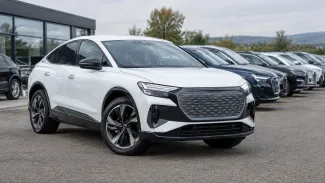
The Audi Q4 e-tron Sportback led the list, followed by the Toyota bZ4X and the Lexus RZ 300e. The Honda Prologue, BMW iX and Polestar 2 also appeared. No Tesla, no Lucid and no Rivian made the top ten, in a segment Tesla once defined.
Tesla's absence has a price explanation. Used Model S values rose 22% and used Model X values 18%, the two largest increases of any used car in the study, whatever the powertrain. Higher asking prices mean longer waits.
Big electric trucks sat longest
The slowest-selling used EV was the Cadillac Escalade IQ, by a wide margin. The GMC Sierra EV, Chevrolet Silverado EV, Volvo EX90 and GMC Hummer EV followed. All are large, heavy and expensive, and all carry very large batteries. Cell supply is concentrated in a few hands: Chinese manufacturers held 73% of the global EV battery market, as we reported on the battery supply chain. A 200 kWh pack is the most expensive single component in those vehicles, and it is the part that sets what a three-year-old example is worth.
One EV for every 31 combustion listings
Autotrader listed 1,384,383 used petrol and diesel cars in the US against 44,434 used EVs, a ratio of about 31 to 1. Electric cars made up 3.2% of the 1,384,383 petrol and diesel listings — or 3.1% of all 1.43 million listings combined. There are also fewer EV models on sale, so a used EV buyer cross-shops less and decides faster. A thin market can move quickly when demand shows up.
What a used EV buyer should check
Battery state of health comes first, then measured range rather than the WLTP or EPA number on the window sticker. Our range calculator built on Bjørn Nyland's test data lets you compare his measured consumption at 90 km/h and 120 km/h for the models he has driven, so the winter figure is not a surprise in January.
Charging access comes second. In the US the network is still being built out; Rivian's Adventure Network reached 1,185 fast-charging ports, as we wrote when the figure was published. Third, run the running costs. Our EV savings calculator puts electricity against fuel per 100 km, and the EV catalog holds full specifications for 67 models.
What travels to Europe
The iSeeCars figures describe US listings in September 2026 and nothing more. American fuel prices, the expired federal credit and the local model mix all shape them, so the 41.9-day average says little about a Czech or German forecourt. European buyers can check local charging prices in our database of 483 locations before signing anything. iSeeCars has not published an equivalent breakdown for European markets.
Source: https://insideevs.com/news/814282/used-evs-selling-fast/