
What Denza actually put on sale
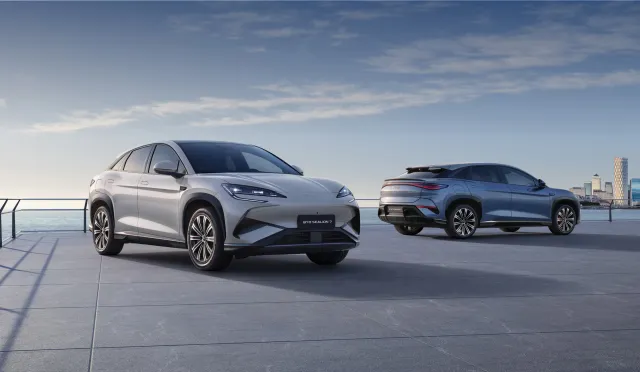
Two versions, both with the same 130.15 kWh LFP Blade Battery 2.0: the N8L EV Premium at 299,800 yuan (~$45,000) and the Flagship at 329,800 yuan (~$49,000). Dimensions are unchanged from the plug-in hybrid N8L launched in October 2025 — 5,200 mm long, 1,999 mm wide, 1,820 mm high, 3,075 mm wheelbase — with a 2+2+2 six-seat layout.
Chassis hardware is the interesting part for a European audience: Disus-A body control with dual-chamber air suspension, an 800V electrical architecture, and God's Eye 5.0 driver assistance with highway navigate-on-autopilot and remote parking. Inside there are six displays, an AR head-up display, NAPPA leather, a Devialet audio system. On paper this is a Mercedes GLS-sized vehicle positioned below the EQS SUV on price.
The assisted-driving claim deserves a caveat. Chinese brands are shipping highway NOA now while legacy European makers are slipping. Hyundai has already pushed its own Tesla FSD rival to 2029, and BMW's unified 3D navigation and assist view only reaches the iX3 this October. Feature parity in marketing copy is not feature parity in a Czech D1 motorway lane at night.
960 km CLTC: doing the arithmetic
CLTC-P is run at an average speed of roughly 29 km/h with long idle periods. It rewards exactly the vehicles that struggle most in real use: heavy, boxy, high frontal area. Convert the claim into consumption and it becomes obvious why the figure looks the way it does.
| Cycle | Range | Consumption |
|---|---|---|
| CLTC (claimed) | 960 km | 13.6 kWh/100 km |
| WLTP (our estimate) | ~750 km | ~17.4 kWh/100 km |
| Real world, 120 km/h (our estimate) | ~470 km | ~27.7 kWh/100 km |
The WLTP and real-world rows are our estimates, not BYD's figures. WLTP Class 3b averages about 46.5 km/h — roughly 1.6 times the CLTC-P average — with a higher maximum speed and far less idle time, so the same 2.5-tonne, 5.2-metre body is asked to push more mass through more air. That is why we use a CLTC-to-WLTP factor of around 0.78 as our working estimate rather than a published number, and why the direction of the correction is consistent across every heavy electric SUV we have data on. In Bjørn Nyland's 120 km/h tests, large electric SUVs routinely land 30–40% below their WLTP rating. If you want to run the same maths on a car you are actually considering, the real-world range calculator uses Nyland's measured figures rather than cycle results.
Charging: five minutes, if you can find a 1 MW plug
Denza quotes 10–70% in five minutes and 10–97% in nine. Run that through the pack: 60% of 130.15 kWh is 78.1 kWh, which is an average of 937 kW across the session. The full 10–97% window means 113.2 kWh in nine minutes, an average of 755 kW. Those are real numbers, but they only exist on BYD's own megawatt flash-charging hardware.
Europe's public CCS network tops out at 350–400 kW at a handful of sites, and a 130 kWh pack on a 400 kW charger will spend most of its life well below that. The car is not the bottleneck — the grid connection is. A five-minute stop in China is a 25-to-30-minute stop on the A2 near Brno today.
Price: 299,800 yuan is not €40,000 in Europe
Direct currency conversion never survives VAT, EU import duty, homologation, shipping and dealer margin. The honest comparison is against what a European buyer can actually order. The Kia EV9 carries a 99.8 kWh pack, up to 563 km WLTP, and starts around €70,000 in most EU markets. The Volvo EX90 runs 111 kWh and roughly 600 km WLTP, from above €85,000. Denza is offering 30% more usable battery than an EV9 for about a third less money in nominal terms: 299,800 yuan (~$45,000) in China against roughly €70,000 for the Kia in Europe. Put both into the same currency and the gap widens to around 45%, though that figure reflects Chinese cost structures and European taxes as much as the two vehicles themselves. Either way, the price advantage exists in China, not in Europe.
Denza has not confirmed a European launch for the N8L EV, and BYD's premium sub-brand has been rolled out across Europe gradually rather than at once. Treat the yuan price as a Chinese-market signal, not a European forecast. It is, however, a very clear signal about the cost structure European manufacturers are competing against.
Cost per 100 km: where the luxury SUV gets expensive
Using our ~27.7 kWh/100 km motorway estimate: at a Czech household tariff of about €0.24/kWh that is €6.65 per 100 km. On public DC charging at €0.60/kWh it becomes €16.62 per 100 km. A diesel SUV at 8 l/100 km and €1.55/l costs €12.40. On long trips, fast-charging a 130 kWh luxury EV currently costs more than burning diesel — which is why route planning around cheaper stalls matters. Our cheapest superchargers list covers 483 locations across Europe, and the charging cost calculator will run your own route and tariff.
What to do with this
Ignore the CLTC figure entirely. It is a homologation artifact, and it belongs in the same drawer as Hongqi's perovskite solar roof, where the kWh-per-day arithmetic also failed to line up with the marketing promise. If the N8L EV reaches Europe, ask for three things: the WLTP number, the measured charging curve between 10% and 80%, and the price after tax. Everything else is packaging.
What remains open: BYD has published no WLTP figure and no charge curve for this car, and the five-minute claim depends on infrastructure that does not exist outside China yet. Until both appear, the 960 km badge is a claim, not a measurement.
Source: https://electrek.co/2026/09/15/byd-reveals-new-luxury-ev-suv-960-km-range-for-45000/