
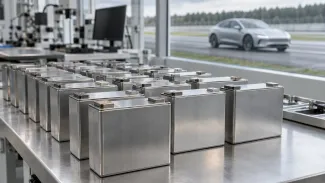
The claim: 500 Wh/kg and 1,000 km
Geely announced the pilot programme on LinkedIn and InsideEVs reported the details. The battery is claimed to reach a cell-level energy density of 500 Wh/kg — roughly twice the density of Geely’s current “Golden Brick” cells. On paper, that would allow a pack with over 1,000 km of range while still fitting in a conventional passenger car footprint.
Geely also quotes a service life of more than 600,000 miles. That is not a warranty, it is an engineering target. For context, most current lithium-ion packs are warrantied for 160,000–240,000 km in Europe, so 600,000 miles (about 965,600 km) would be roughly four to six times that.
Why I’m not calling this a breakthrough yet
As someone who maintains a catalogue of 67 production EVs, I look for cars I can actually buy, then measure. We have no Bjørn Nyland real-world data for a Geely solid-state pack, and that is exactly the point: the pack does not exist in a production car yet. Bjørn Nyland’s tests have shown repeatedly that winter and motorway driving cut 20–30 per cent off official range for current lithium-ion packs. If the 1,000 km figure is a CLTC or WLTP-type laboratory number, a realistic winter highway range could land closer to 700–800 km. You can see the pattern for yourself in our real-world range calculator.
Then there is the scaling problem. Geely says “pilot deployment across portfolio brands” from 2027. That usually means a small fleet of test cars, not a price-list option. Tesla’s old line still applies: prototypes are easy, scaling production is very hard.
Where Volvo fits — and where it doesn’t
Volvo is an obvious candidate. It is a premium European brand, it already uses Geely’s SPA2 platform for the EX90, and it can absorb the higher cost of early solid-state cells more easily than a budget brand. The current Volvo EX90 is rated around 614 km WLTP, so a 1,000 km pack would be a 60 per cent jump if the packaging allows it. But Geely’s portfolio also includes Polestar, Lotus, Zeekr, Smart, Lynk & Co and Proton. The first solid-state test cars could just as easily appear under a Chinese brand, not a Swedish one.
That matters for European buyers. Until Volvo or Polestar confirms a specific model, this remains a supplier technology pilot. If you are holding off on an EX90 or EX60 because of solid-state rumours, you may be waiting until the late 2020s for a real product — and even then, likely at a premium price.
The cost calculation no one is showing you
More range is only useful if the electricity price makes sense. Using our charging cost calculator, a 1,000 km trip at a realistic 20 kWh/100 km consumption would require about 200 kWh of energy. At a typical DC fast-charging price of €0.45 per kWh, that is €90 for the full range, or €9 per 100 km. A comparable diesel averaging 5 l/100 km at €1.60 per litre costs €8 per 100 km. In other words, if you rely mainly on expensive fast charging, a huge battery does not automatically beat a diesel on running costs — the advantage still comes from cheap home or overnight AC charging.
Our supercharger database tracks 483 locations across Europe, and price differences are enormous. A 200 kWh pack makes choosing the right charging tariff far more important than it is with today’s 70–110 kWh packs.
What we know about competing solid-state efforts
Nio already sells a 150 kWh semi-solid battery in China, and its ET7 advertises around 1,000 km CLTC — though real-world highway range is lower. Toyota has been promising solid-state production around 2027–2028, initially in very small volumes. Geely’s 500 Wh/kg cell claim puts it in the same conversation, but the industry has a long history of announcing cell-level density figures that drop significantly when assembled into a full pack with cooling, structure and buffer capacity.
Battery supply chain emissions are another open question. As we noted when reporting on CATL’s carbon-neutral plants, the supply chain accounts for about 80 per cent of battery emissions. A solid-state pack may be safer and more energy-dense, but it will not make that problem disappear.
Practical takeaway
Do not base a purchase decision on this announcement. The solid-state Volvo you might want is still years away, and the first pilots may not even carry a Volvo badge. If you need an electric car today, the current EX90 or EX60 already offers 600 km WLTP — and with the right charging tariff, it costs less to run than you might expect. For those who want to track how real-world range and charging costs evolve, our Bjørn range calculator and charging cost calculator are updated as new data arrives. Charging infrastructure in Scandinavia is also changing rapidly — we covered the E.ON and Clever split of their 157-point fast-charging network earlier, and it is a reminder that range is only half the equation.
Source: https://insideevs.com/news/805618/volvo-geely-solid-state-2027/