
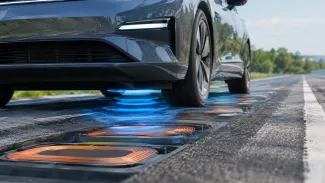
What Honda built
Transmitter coils sit under the asphalt. A receiver on the vehicle's underside picks up the power, so nothing has to stop and no cable has to be plugged in. Honda's R&D subsidiary developed the hardware with the Japanese construction company Taisei. Peak transfer is quoted at 150 kW, matched to traffic moving at highway speed.
The first installation is deliberately small: just over a tenth of a mile of public highway in Chiba. Honda calls this stage demonstration testing and says it will install the infrastructure and prepare the stretch for commercial deployment. The engineering is real; the scale is not, yet.
Taku Ueda, Honda's chief engineer of R&D, told Nikkei Asia that charging while driving could reduce the number of battery cells in future EVs and ease charging anxiety among Japanese drivers. Fewer cells means a cheaper car and a lighter one.
The arithmetic of 300 metres
At 120 km/h a car covers 300 metres in nine seconds. Nine seconds at 150 kW is 0.375 kWh, and that figure is already optimistic, because inductive transfer loses more energy than a cable does. A compact EV using 19 kWh/100 km needs 0.19 kWh per kilometre, so one pass over the strip is worth about two kilometres of range. Subtract the energy the car burns while crossing it and the net gain shrinks further.
Full power along a full kilometre of equipped road at 120 km/h comes to 1.25 kWh per vehicle. Delivering 60 kWh, which a 350 kW DC charger does in roughly ten minutes, would take 48 kilometres of electrified asphalt at perfect alignment and zero losses. Honda has 300 metres of that road.
Why the trucks go first
The maths suits heavy vehicles better. A 40-tonne electric truck at 90 km/h uses around 1.2 kWh per kilometre, so it draws about 108 kW continuously. A 150 kW transfer at 90% efficiency feeds 135 kW into the pack. The strip covers consumption and leaves a surplus near 27 kW, which over 100 km of equipped road becomes about 30 kWh.
Filling a 500 kWh truck battery that way would take more than 1,600 km of road. The commercial argument is not about a full battery. It is about the diesel bill on routes a fleet drives every day. When we checked the diesel savings claim behind FedEx's 300-million-dollar electric truck order, the result depended on high annual mileage and cheap electricity. The same conditions apply to a road that only pays back on fixed corridors.
Other attempts
Honda is not the first to try this. Electreon installed a short wireless charging stretch in Detroit, as InsideEVs noted in its report on the Honda announcement. Porsche offers an inductive pad for the Cayenne Electric, though that one charges a parked car, and Tesla has demonstrated wireless charging for the Semi. Germany went a different route with overhead catenary lines for trucks on the A5 and A1. That approach shares the same weakness: only the equipped route helps.
What a buyer should take from this
Little, for now. The 2027 test is Japanese, it covers one short strip, and it is aimed at fleets. No European programme, price or production car with a receiver has been announced. For route planning and running costs today, our supercharger database lists 483 locations with their prices, and the charging cost calculator works out what a stop costs on your own consumption. At €0.45/kWh, 0.375 kWh of wireless energy is worth 17 cents. That is the value of one pass over a 300-metre strip.
The more interesting claim is the one about smaller batteries. European electric car sales rose 45% to 1.64 million units as cheaper models reached showrooms, and cheaper usually means a smaller pack. If in-motion charging ever let a car carry 20 kWh less, the saving would be counted in thousands of euros per vehicle, not in cents per pass.
Honda has not published the transfer efficiency at highway speed or the cost of the 300-metre installation. Those two figures will decide whether Chiba gets a second stretch of road.
Source: https://insideevs.com/news/810955/honda-wireless-highway-ev-charging/