
What is AllDayEnergy?
Announced on 27 July 2026, AllDayEnergy is the new umbrella brand for all Hyundai, Kia, and Genesis energy services. The group is consolidating its previously scattered pilot projects — from the large-scale V2G trial on Jeju Island to V2H emergency power tests in the US during wildfires — under one unified identity.
The rollout is modular. Phase 1 (second half of 2026, UK first) is V1G smart charging: the charging time is dynamically adjusted to real-time electricity tariffs, grid loads, and user preferences. Electricity flows only one way — grid to car. Phase 2 will introduce full bidirectional charging: V2G (feeding power back to the grid) and V2H (powering your home).
The services will be accessible directly through the Hyundai and Kia vehicle apps, eliminating the need for third-party solutions. According to Woong Tae Hwang, Vice President and Head of the EV Energy Strategy Group at Hyundai Motor Group, the goal is to let customers "seamlessly optimize their energy usage, reduce their energy costs, and contribute to grid sustainability."
European angle: UK first, then continental Europe
The UK launch in late 2026 makes sense — the British market has dynamic electricity tariffs (like Octopus Energy's Agile or Intelligent Octopus) that pair well with smart charging. From there, Hyundai and Kia plan to expand into continental Europe, the USA, and Korea.
For European readers, the key question is: how much can you actually save? Let's put some numbers on it. Our supercharger database shows that public DC fast charging in Europe ranges from €0.35/kWh (cheapest Tesla Superchargers in Spain) to over €0.79/kWh (Ionity in Germany without a subscription). Home charging, by contrast, typically costs between €0.08/kWh (off-peak in France) and €0.35/kWh (peak in Germany).
If AllDayEnergy's smart charging shifts your home charging to the cheapest off-peak hours — say from €0.30/kWh to €0.15/kWh — and you charge a 77 kWh battery (like the Kia EV6 Long Range) from 10% to 80% (54 kWh usable), you save €8.10 per full charge. Over 20,000 km/year at roughly 18 kWh/100 km real-world consumption, that's about €162/year in charging cost savings — just from smart scheduling, without even touching V2G.
For comparison, our EV savings calculator shows that switching from a diesel car (€1.55/litre, 6 L/100 km) to an EV charged at €0.15/kWh saves around €1,100/year in fuel alone. Smart charging adds another ~15% on top of that.
Bidirectional charging: the real game-changer (later)
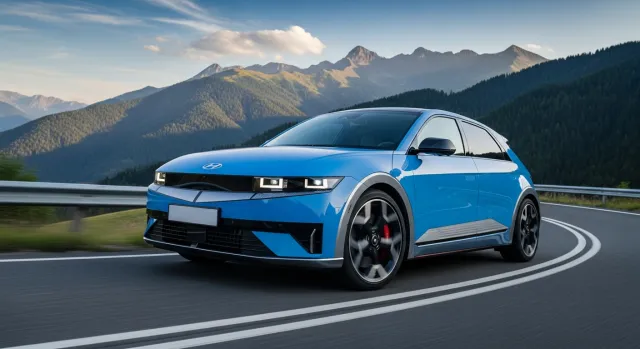
Phase 2 — V2G and V2H — is where AllDayEnergy gets interesting. Hyundai and Kia already have vehicles with bidirectional capability: the Hyundai Ioniq 5, Kia EV6, and Genesis GV60 all support V2L (vehicle-to-load) and, with the right hardware, V2G.
In the Netherlands, Hyundai ran a V2G pilot in Utrecht where Ioniq 5 owners could sell power back to the grid during peak hours. The economics are compelling: if you can buy power at €0.10/kWh off-peak and sell it back at €0.40/kWh during peak, the margin is €0.30/kWh. With a 77 kWh battery (usable capacity ~70 kWh), you could theoretically earn up to €21 per full cycle — but battery degradation and round-trip efficiency losses (typically 10–15%) eat into that.
Bjørn Nyland's real-world tests on the Ioniq 5 show a charging efficiency of about 92% at 50 kW DC. For V2G, round-trip efficiency (AC charging → battery → AC back to grid) is lower — expect 80–85%. That means the real margin is closer to €0.20/kWh, or €14 per full cycle. Still meaningful, but not a gold rush.
Our real-world range calculator (based on Bjørn Nyland's data) can help you estimate how much battery capacity you actually have available after accounting for your daily driving needs — crucial for V2G planning.
What about hardware and compatibility?
AllDayEnergy will work through the vehicle's existing app, which is a smart move — no extra dongles or third-party accounts. But you'll still need a compatible bidirectional wallbox. In Europe, the leading options are Wallbox Quasar 2, myenergi zappi (with V2G support), and Indra V2G. Prices range from €800 to €1,500 installed — a significant upfront investment.
For V2H (home backup), the hardware is simpler: a standard bidirectional inverter and a transfer switch. During a power outage, your EV can power essential circuits for days. Hyundai already tested this in California during wildfire season — a Kia EV9 with 99.8 kWh battery can run a typical home for 3–5 days without grid power.
Competition: who else is doing this?
Hyundai and Kia aren't alone. Volkswagen is rolling out its own V2G ecosystem via the ID. models and the Elli energy brand. Nissan has been doing V2G with the Leaf for years (though CHAdeMO is fading in Europe). Ford offers V2H with the F-150 Lightning (not sold in Europe). And MG (SAIC) has V2L on most models but no integrated V2G service yet.
The key differentiator for AllDayEnergy is cross-brand unification — one app for Hyundai, Kia, and Genesis. That's a big deal for multi-EV households. If you have a Kia EV6 and a Hyundai Ioniq 6, you manage both from one interface.
Practical takeaway for European buyers
If you're considering a Hyundai or Kia EV today, here's what AllDayEnergy means for you:
- Phase 1 (smart charging) is coming to the UK in late 2026, continental Europe likely in 2027. If you already have a dynamic tariff, you can save €100–200/year on charging costs.
- Phase 2 (V2G/V2H) will follow, but requires a bidirectional wallbox (€800–1,500). The payback period is 3–5 years if you actively trade energy.
- Your car is already capable — Ioniq 5, EV6, and GV60 all support bidirectional charging. No need to wait for a new model.
- Check your local grid operator — some European countries (like Germany and the Netherlands) have favourable V2G regulations; others (like Czechia) are still catching up.
For now, the most practical step is to sign up for a dynamic electricity tariff and start smart charging manually (or via a third-party app like Tibber). When AllDayEnergy arrives in your market, the transition will be seamless.
For more context, read our analysis of Tesla Supercharging prices across Europe and our real-world highway range comparison to see how far these Hyundai/Kia models actually go on a charge.
Will AllDayEnergy work with older Hyundai and Kia EVs (e.g., 2022 Ioniq 5)?
Yes — the Ioniq 5, EV6, and GV60 from 2022 onward support bidirectional charging hardware. However, you may need a software update (likely OTA) to enable AllDayEnergy services. Older models like the Kia e-Niro or Hyundai Kona Electric do not support V2G/V2H, but may still benefit from Phase 1 smart charging if they have a connected app.
Is AllDayEnergy free, or will there be a subscription fee?
Hyundai and Kia have not announced pricing yet. Given the trend in the industry (Tesla charges $9.99/month for Premium Connectivity, Ford charges for BlueCruise), a small monthly fee for V2G energy trading is likely. Phase 1 smart charging may be included free with the vehicle's connected services.
Can I use AllDayEnergy with a non-Hyundai/Kia wallbox?
For Phase 1 (smart charging), any OCPP-compatible wallbox should work — the app controls the charging schedule. For Phase 2 (V2G/V2H), you need a bidirectional wallbox that supports the ISO 15118-20 standard. Hyundai/Kia will likely recommend certified partners, but open standards mean third-party options should work.