
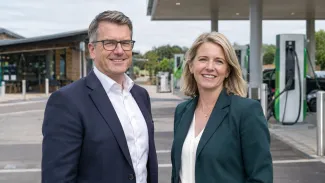
What the two companies agreed
This is a swap, not a simple supply contract. Roadchef operates 12 BP forecourts from now on, selling BP-branded fuel and running the wild bean cafe. In exchange, BP Pulse gets access to more than 30 Roadchef motorway service areas for its ultra-fast charging hardware, with the first installations due in 2027.
Tim Gittins, Roadchef's chief executive, framed the deal around en-route charging: "Under the UK's transition to zero-emission vehicles, motorway service areas will play a critical role in improving the availability of en-route charging points." Jo Hayward, BP's VP for mobility and convenience retail UK, said the agreement builds on the existing fuel supply relationship between the two companies. Full announcement on roadchef.com and the original report on electrive.com.
Roadchef's charging build-out so far
Roadchef has been adding charging in stages. In October 2024 it announced 650 new fast-charging stations across its motorway sites, part of a £20bn infrastructure package put together by Macquarie. A year earlier, in September 2023, Gridserve and Roadchef started building Electric Super Hubs at six locations with more than 50 chargers between them.
So Roadchef already runs hardware from more than one charging operator. Adding BP Pulse does not replace Gridserve. It means a driver pulling into a Roadchef site may find chargers from either network depending on the location, with different apps, different tariffs and different payment methods.
1,000 bays across 30 sites
Roadchef's 2030 target is 1,000 charging bays. Spread across roughly 30 service areas, that works out at about 33 bays per site on average. The number of sites matters less than the number of working bays per site. One site with 30 bays and a queue behaves very differently from three sites with 10 bays each.
For scale, our supercharger database tracks 483 charging locations across Europe with their per-kWh prices. Readers planning a UK trip can benchmark motorway rates against what the same journey costs on the continent using the cheapest chargers list.
What a motorway kWh costs
Take 79p/kWh as the example rate for UK ultra-rapid motorway charging, and a car that uses 20 kWh/100 km. That is £15.80 per 100 km. The same car charged overnight on a UK off-peak EV tariff at around 7p/kWh pays roughly £1.40 per 100 km. Same electricity, roughly 11 times the price.
The gap against petrol is smaller than most drivers expect. A combustion car at 6.5 l/100 km and £1.35 a litre costs about £8.78 per 100 km. So on the motorway, rapid charging at 79p/kWh can cost more per kilometre than petrol, while home charging costs a fraction of it. You can run your own numbers in our charging cost calculator.
Range at motorway speed
Extra bays help only if the car can reach them. Motorway speeds push consumption above the WLTP figure, which shortens the distance between stops and makes each charging session more expensive in absolute terms. Our real-world range tool, built on Bjørn Nyland's test data, lets you check a specific model at highway speed before you plan a route. Model specifications and battery sizes are in the EV catalog.
The UK target behind the build-out
The UK's ZEV mandate raises the required share of zero-emission sales every year toward 2030, which puts pressure on motorway charging to keep pace with the cars being sold. Parliament has also been weighing tariffs of up to 35% on Chinese EVs while trying to keep EU market access, a debate we covered in this article on UK tariff plans.
Heavy vehicles are a separate problem. Roadchef's Gittins mentioned leisure and HGV drivers in the same breath. Charging a truck at a motorway service area needs far more power per bay than a passenger car, and the economics are still being worked out, as we looked at in the FedEx electric truck order. Charger hardware also has to survive real use, a point driven home by the Nanning megawatt charger inspection after a video showed children using it as a swing.
What is still missing
The agreement covers more than 30 Roadchef service areas and starts in 2027, but Roadchef has not said how many of the 1,000 bays will come from BP Pulse and how many from Gridserve. The 650-charger figure from October 2024 and the 1,000-bay target from 2026 are separate announcements with no published reconciliation. Nothing in the announcement sets a price for the charging itself.
Source: https://www.electrive.com/2026/10/05/roadchef-and-bp-pulse-join-forces-on-ev-charging/