
The build-out in numbers
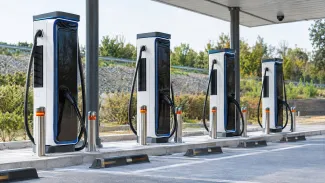
Water is building along highways in Gyeonggi, Chungcheong, Gangwon and Gyeongsang. Each of the 23 locations gets at least two ultra-fast chargers rated at 400 kW.
The full charger count is 123: 62 units at 400 kW, 46 at 200 kW and 15 at 100 kW. That makes the 400 kW hardware slightly more than half of the total. Every charger carries both NACS and DC Combo connectors, so Tesla drivers need no adapter and CCS cars are covered as well. The plan was reported by electrive, and the operator posted its own notice on watercharging.com.
First station at Cheongju Rest Area
The opening site sits at Cheongju Rest Area on the Seoul-bound side of the Gyeongbu Expressway, the main corridor between Seoul and Busan. Water says it is the first highway rest area in South Korea to offer 400 kW chargers. Besides the two 400 kW units, the site has two 200 kW chargers.
Yoo Dae-won, head of the EV charging business unit at Brite Energy Partners, said rest areas are the locations where charging speed directly affects a driver's time. That is why the company joined the Korea Expressway Corporation's infrastructure expansion project with the highest-output hardware it could deploy.
How fast the cars actually charge
A 400 kW figure describes the charger, not the car. Only models with 800-volt and higher architectures can approach that output: the Hyundai and Kia E-GMP cars, the Genesis models built on the same platform, and 800-volt cars from Porsche and Audi. A 400-volt model plugged into a 400 kW stall draws what its battery management allows, often 100 to 150 kW.
Water states that Tesla models will reach roughly 120 to 200 kW through NACS, depending on the model. The 15 chargers rated at 100 kW will serve cheaper, slower-charging cars, which make up a growing share of the Asian market. Our September figures for Chinese NEV sales put BYD alone at 456,713 units, and low-cost models such as the Jetta-branded electric sedan in China at €10,600 are landing in the same price band.
Peak power also matters less than a flat charging curve across a wide state-of-charge window. Our real-world range and charging tool, built on Bjørn Nyland's test data, shows what a specific model does on a long drive rather than on a press sheet.
The promotional tariff
Water's members pay 294 won per kWh, about €0.19, for one year from each station's opening date. The company says that is roughly 100 won (€0.07) below the Ministry of Climate, Energy and Environment's roaming tariff for chargers of 200 kW and above. That implies a ministry reference price of about 394 won, or €0.25, per kWh.
At a consumption of 18 kWh/100 km, €0.19 per kWh works out to €3.42 per 100 km. The same distance at €0.60 per kWh, a figure many European drivers know from ad-hoc high-power charging, would cost €10.80. Our charging cost calculator takes your own consumption and tariff, and the cheapest Superchargers map tracks prices across 483 locations in Europe if you want the comparison.
Water's network after the build-out
Once all 23 sites are live, Water expects to operate 397 chargers at 73 highway rest areas. The promotional rate of 294 won per kWh applies at every one of them, but it expires station by station, one year after each opening. After that date the price returns to the operator's standard tariff.